

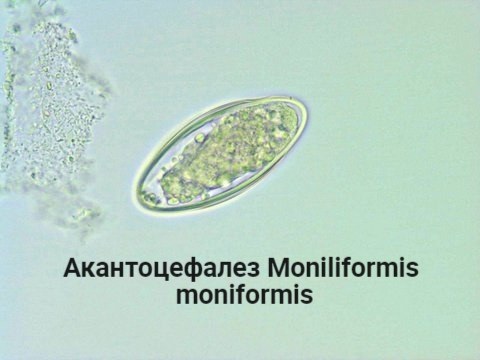
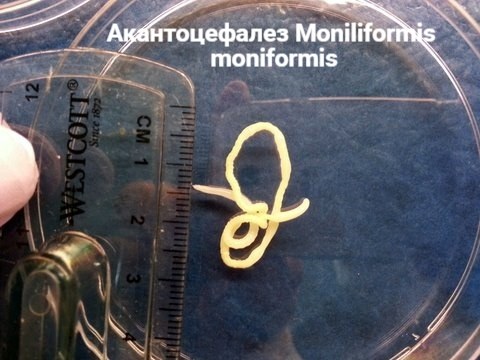
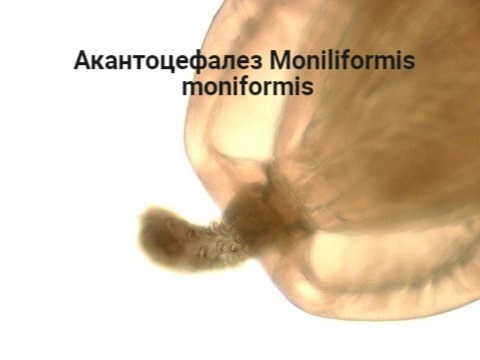
The correct answer to the parasitology problem: Acanthocephaliasis (thorny-headed worms), caused by Moniliformis moniliformis.
This was a difficult case.
The diagnosis of acanthocephaliasis can be made by recognizing the armed proboscis with recurved hooks protruding from the worm.
Most cases of human acanthocephaliasis are caused by Macracanthorhynchus hirudinaceous and Moniliformis moniliformis, whose eggs can be differentiated by morphology. M. hirudinaceous eggs are thick-shelled, with a dark, textured shell, whereas M. moniliformis eggs have a thin shell and an oval/elongated shape. Some note that M. moniliformis eggs resemble Enterobius vermicularis eggs, but they are larger, more elongated, and do not have flattened sides like Enterobius vermicularis.
It should be noted that M. moniliformis is transmitted by ingesting arthropods such as beetles and cockroaches. This explains why this infection is observed in young children, as well as in populations that consume arthropods for medicinal or dietary purposes.


