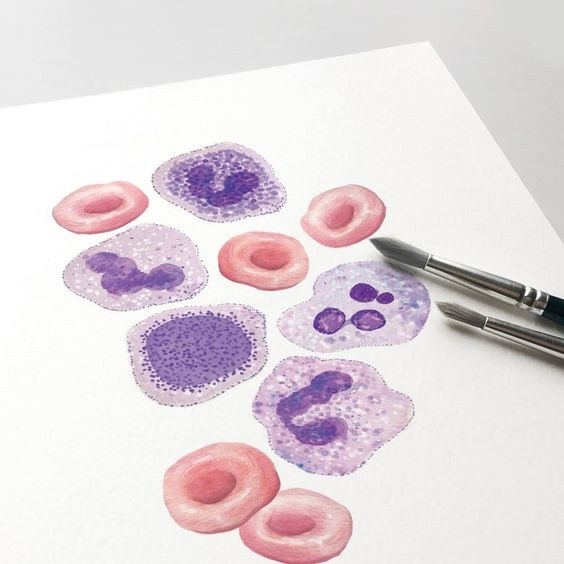
✅How to describe the morphology of any cell using words? This is important for every morphologist to know: ✔cell size and shape, generation type – micro-, meso-, macro-generation, mixed types, etc.; ✔nucleo-cytoplasmic ratio (high, medium, low, or shifted towards the nucleus or cytoplasm); ✔cytoplasm – volume (abundant, moderate, scanty, almost undetectable – “bare nucleus cell”), clarity of borders (clear, indistinct, breaks present, not traceable throughout), contours (even, scalloped, etc.), color (blue, grayish-blue, pink, pinkish-violet, basophilic), how it is stained (uniformly, non-uniformly, glassy, presence of perinuclear clearing), presence of granularity (abundant, scanty, covering the nucleus, coarse, dust-like, uniform, etc.), inclusions, vacuoles; ✔nucleus – number (uni- or multinucleated cells), location (central, eccentric, occupying almost the entire cell), size (small, medium, large, giant), shape (round, oval, polygonal, elongated, bean-shaped, club-shaped, cleaved, twisted cord-like, etc.), stainability (hypochromia, hyperchromia, aniso-chromia, uniformly stained), presence of mitotic figures; ✔chromatin structure – finely dispersed, homogeneous, delicate reticular, fine- or coarse-grained, clumpy, chromatin condensation along the nuclear membrane edge, etc.; ✔nucleoli – presence (present, absent), number, shape (round, irregular), size, color, clarity of borders, prominence of the perinucleolar rim.
Algorithm for Describing Cell Morphology in Microscopy
Key criteria for describing cell morphology: assessing size, nucleo-cytoplasmic ratio, cytoplasm structure, nuclei, chromatin, and nucleoli.