

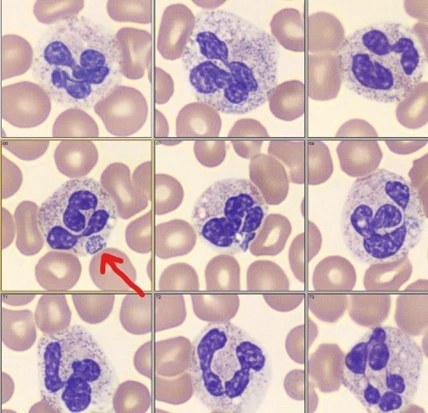
✅A 70-year-old woman was admitted to the hospital with primary complaints of 6 days of fever, chills, weakness, headache, and dizziness. ✅Her medical history included asthma, type 2 diabetes, and exercise-induced ventricular tachycardia. The patient had also been seen 5 days prior to the current visit for abdominal pain, nausea, and fever. The abdominal pain resolved, but her appetite was lost. She admitted to sleeping with her dog in bed during that visit. During all visits, there were no reports of icteric sclera, rash, cough, dysuria, or neck stiffness. ✅The patient was referred for the following investigations: computed tomography, complete blood count with differential, basic biochemistry, liver function panel, coagulogram, blood culture, and blood parasite tests. 🔬In the photo: Upon reviewing the blood smear, round inclusions were found (one of them indicated by an arrow). These inclusions represent Anaplasma phagocytophilum morulae, indicative of human granulocytic anaplasmosis. The infection is tick-borne. A tick bite is painless, and the first symptoms usually appear about a week after the bite. Early diagnosis can be challenging in the initial stage, as laboratory serological tests often yield negative results for antibodies. It is crucial to carefully examine clinical signs and symptoms, travel history, outdoor activities, and animal contact. PCR is the most sensitive and specific diagnostic method. Blood smears can be made to confirm parasite morphology, although patients may have leukopenia, leading to reduced sensitivity of the morphological test.
Laboratory results showed critical hyponatremia (121 mmol/L) and thrombocytopenia (33 thsd/µL). The patient was hospitalized. A 10-day course of doxycycline was prescribed. ⚠Extreme hyponatremia associated with anaplasmosis is uncommon, and its mechanism is unclear; however, all reported cases fit the description of the syndrome of inappropriate antidiuretic hormone secretion.


