

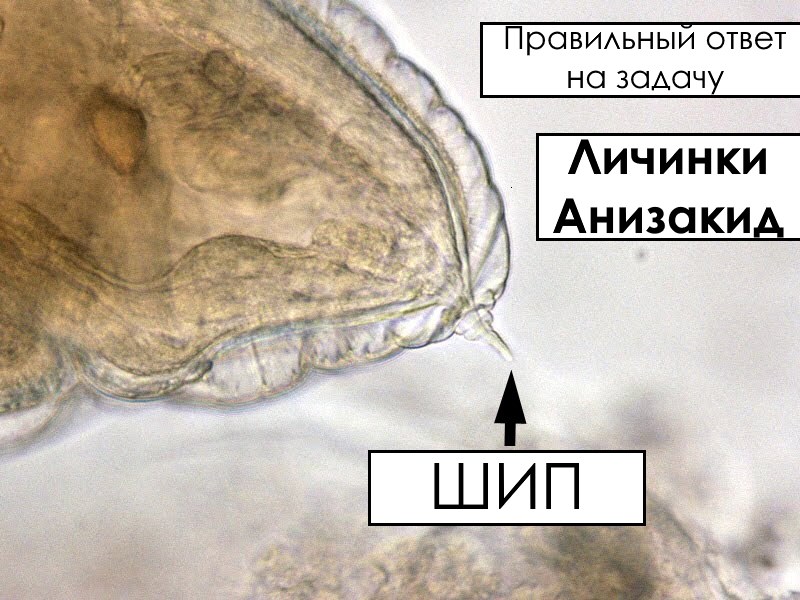
❗ Correct answer to the parasitology case: Anisakis larvae
Thank you to everyone who responded to this case. You all recognized one of the Anisakis nematode (roundworm) larvae.
📖Reference data Anisakiasis is a zoonotic disease whose definitive hosts are marine mammals (e.g., dolphins, seals). Humans become accidental hosts after consuming raw or undercooked seafood containing Anisakis larvae. Larvae cannot complete their life cycle in humans but may attempt to penetrate the human stomach or intestinal mucosa, leading to severe pain and, in rare cases, perforation. A chronic granulomatous reaction mimicking inflammatory bowel disease may also develop. Alternatively, larvae may be “coughed up” or passed in stool.
Some individuals may experience a gastroallergic reaction to Anisakis antigens (from both live and dead worms), leading to urticaria (rash), erythema (redness), angioedema (swelling under the skin), bronchospasm (narrowing of airways), and even anaphylaxis (severe whole-body reaction).
Human anisakiasis is most commonly caused by Anisakis simplex and Pseudoterranova decipiens (formerly Phocanema decipiens).
Diagnosis can be made by identifying the characteristic features of 2 cm long Anisakis larvae, including a posterior “spine” (if present) and 3 poorly formed anterior lips with a small boring tooth.
Anisakiasis is most common in areas where people eat undercooked/raw marine fish or squid. Frequently infected fish include cod (Atlantic or Pacific), Pacific halibut, mackerel, and salmon. Some studies report that over 90% of examined fish are infected. Freshwater fish can also be infected.
These larvae are still easily found in store-bought products. Fortunately, freezing kills the worms and significantly reduces the risk of acute disease. Adequate heat treatment of fish (60° C) or freezing (-20° C for seven days or -35° C for 15 hours) before consumption will kill Anisakis helminths and thus eliminate the risk of acute anisakiasis.


