

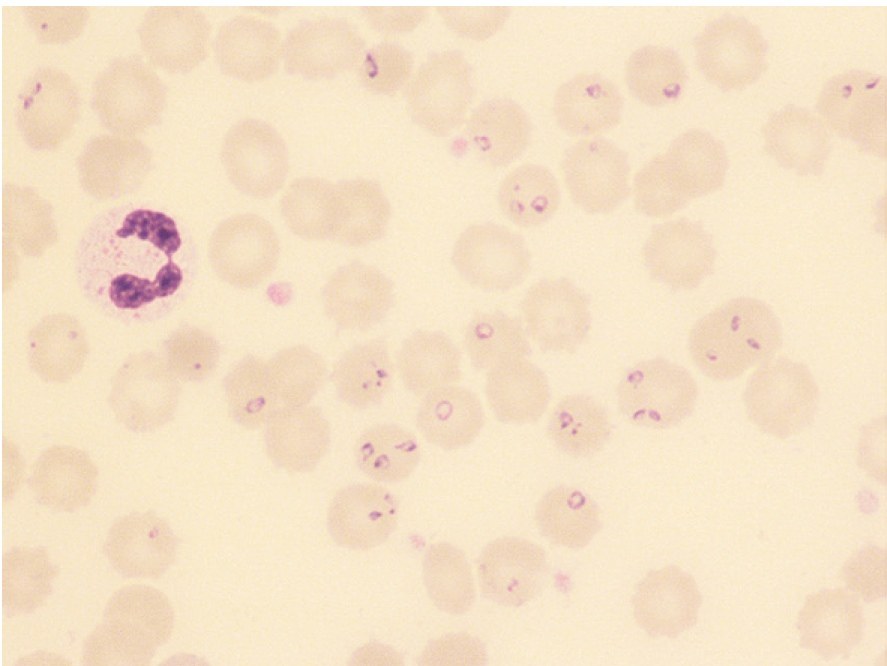
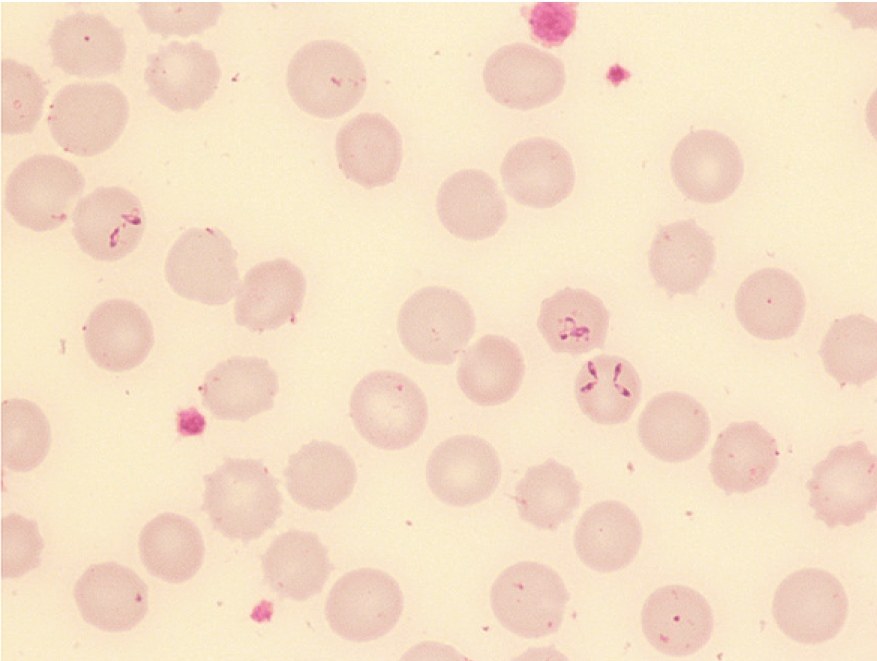
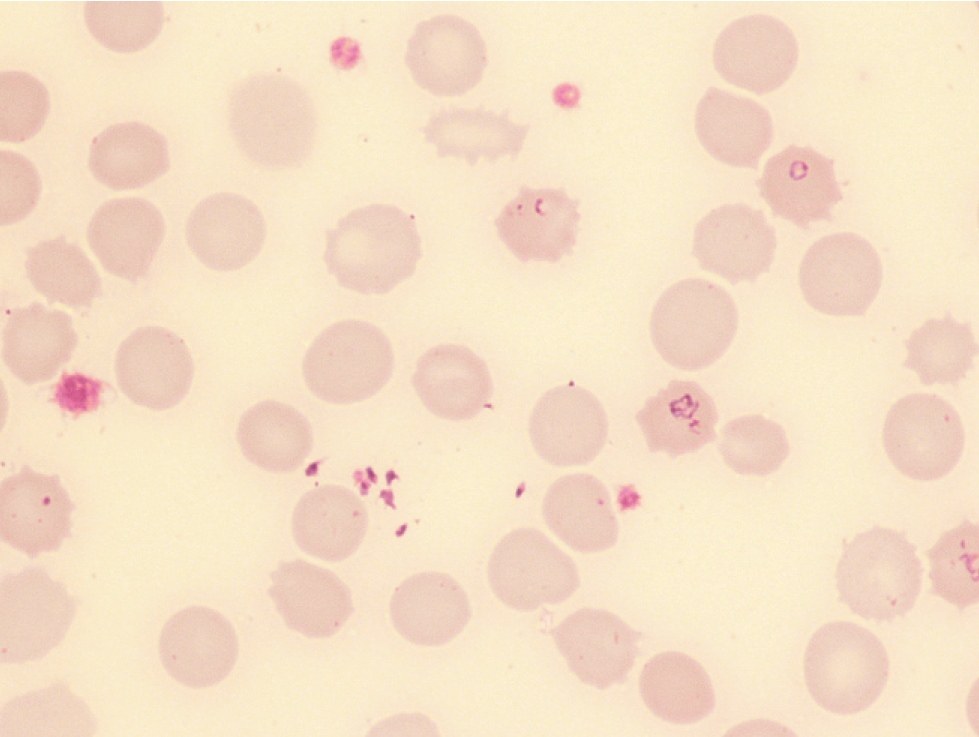
🔬Malaria or not?! A clinical case of an extremely rare parasitosis. ✅A 72-year-old woman, residing in the UK, presented to her local emergency department with a 3-day history of malaise, fever, nausea, abdominal pain, and dark urine. ✅Her initial blood tests showed a hemoglobin of 75 g/L (normal 120-150 g/L) with normal MCV, a platelet count of 69 × 10^9/L, and a normal white blood cell count and differential. ✅The thrombocytopenia prompted a blood film examination, which showed echinocytosis, true thrombocytopenia, and platelet anisocytosis. Over 20% of red blood cells contained small ring trophozoites (photographs below). Pear-shaped pairs were seen, and some red blood cells contained up to six parasites. Pathognomonic tetrads (Maltese cross form), formed by four pear-shaped parasites joined at their pointed ends, were observed and recognized as morphologically diagnostic features of babesiosis. Very rare extracellular parasites were present. ✅PCR confirmed the species as Babesia divergens. This species is found among cattle, where it is common in Western and Central Europe, in contrast to B. microti, which is associated with the northeastern and upper midwestern USA and is well-documented as a cause of human babesiosis. ✅B. divergens infection in humans is very rare, with approximately 50 reported cases. ✅Babesia divergens parasites are 0.4 × 1.5 µm in size. Although classically they are seen as paired forms. There can be one to eight parasites in an erythrocyte. The Maltese cross form is unique to Babesia among members of Apicomplexa, but if it is absent, it can be very difficult to distinguish Babesia from young ring forms of Plasmodium spp., especially P. falciparum. Babesia are smaller than malaria parasites, and some of the larger rings have a white vacuole instead of the pink vacuole containing erythrocyte stroma seen in malaria. Babesia do not form schizonts, and malaria parasites do not form pear-shaped pairs or tetrads. ✅Treatment for babesiosis usually consists of azithromycin and atovaquone, whereas malaria treatment is more often with chloroquine. Sources:
- Bain Barbara J. - Hematology - 101 Morphology Updates, 2023
- Meagan Barry - Intra-erythrocytic, Ring Formed Parasites: A Diagnosis of Malaria or Babesiosis? - 2020


