

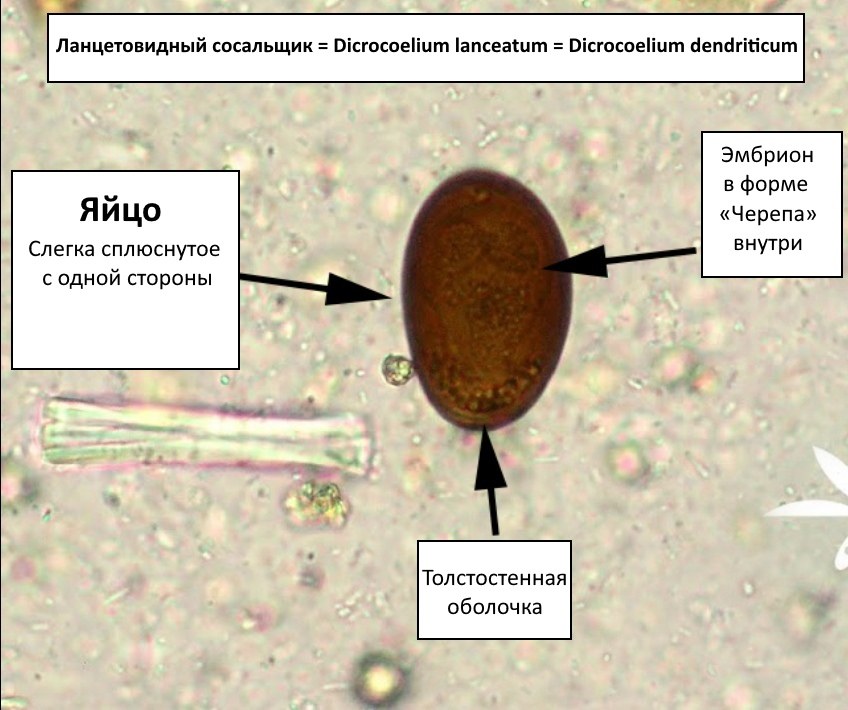
❗Correct answer to the parasitology problem: eggs of the parasite Dicrocoelium dendricitum, which causes the disease dicrocoeliosis.
✅Synonyms: Lancet fluke = Lancet liver fluke = Dicrocoelium lanceatum = Dicrocoelium dendriticum.
✅This is a relatively rare finding in human stool samples. Eggs are small, thick-shelled, often brown due to bile staining. The parasite’s embryo is often easily visible inside the egg (resembles a skull!).
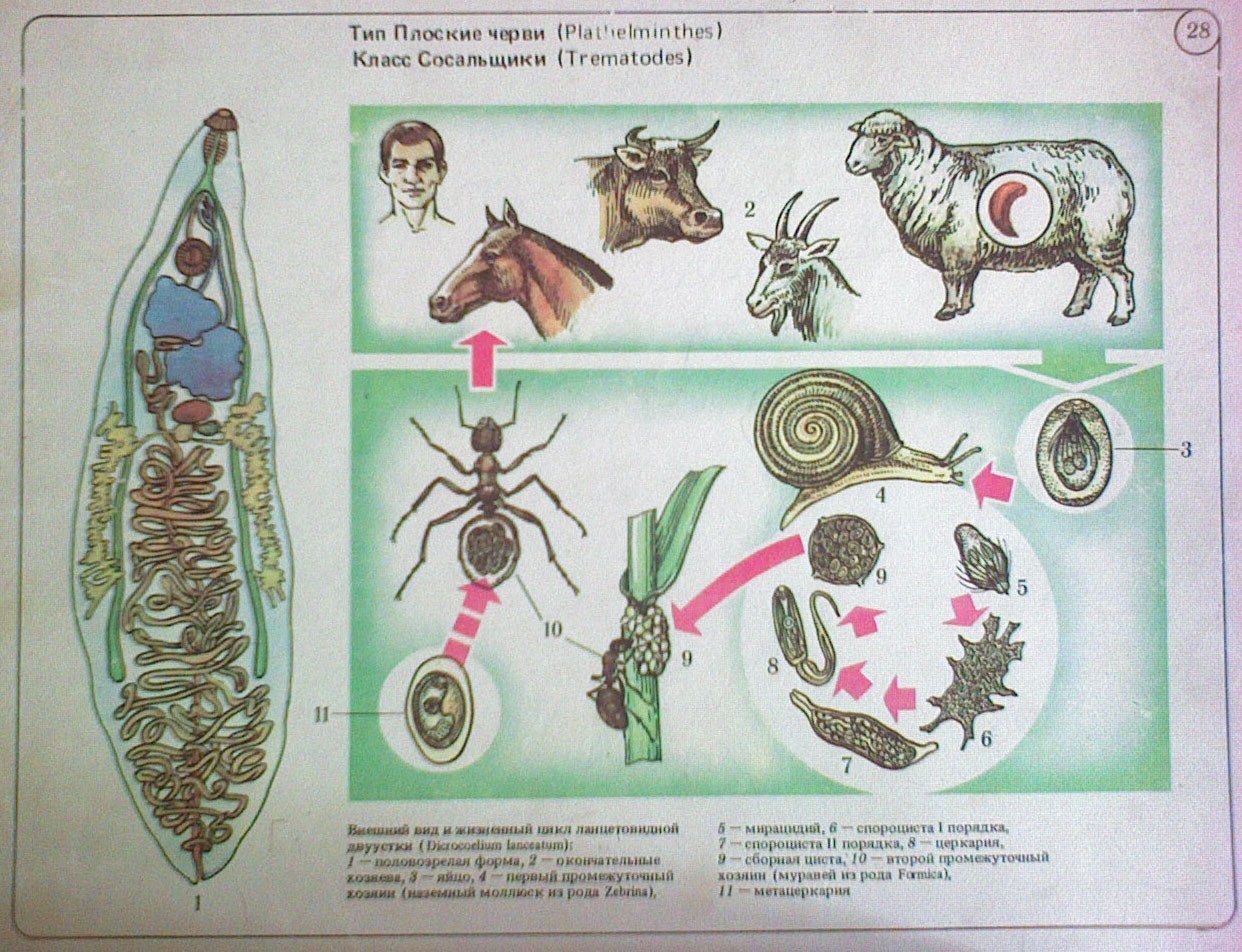
✅D. dendricitum is a very interesting parasite. Its life cycle typically involves ruminants, a snail, and an ant.
✅Most cercariae swallowed by an ant penetrate the crop wall into the body cavity and then into the ant’s subesophageal ganglion. As a result, the ant’s behavior changes. During the day, ants behave normally, but at night they do not return to the anthill, climbing high onto grass stalks and firmly holding onto a blade of grass with their mandibles (night zombies!). Sheep and other hoofed animals (goats, pigs, horses, donkeys; as well as camels, hares, bears, dogs, foxes), by eating grass along with infected ants, become definitive hosts. Livestock management practices can reduce the incidence of infection. This includes avoiding grazing animals early in the morning or late in the evening when ants are more likely to climb to the top of a blade of grass.
✅Humans can become infected by consuming cattle liver affected by dicrocoeliosis, as well as by accidentally ingesting infected ants with food.
💎Find more useful materials on parasitology in our library 🧪LAB-TESTS.


