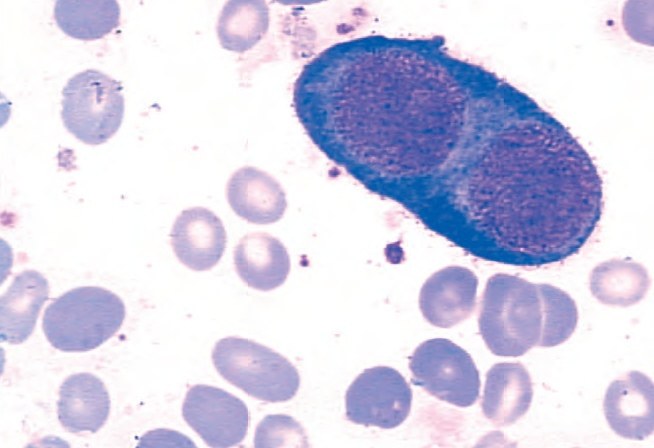
BINUCLEATED MEGALOBLAST. Megaloblast (megaloblastus; megalo- large + Greek blastos germ, embryo) is a progenitor cell of erythropoiesis, characterized by an abnormal shape and unusually large size. IN THE PHOTOGRAPH. Bone marrow aspirate from a patient with pernicious anemia. The giant cell is a binucleated megaloblast, almost at the end of mitotic division. In both nuclei, the chromatin is very fine, pearly or granular. Nucleoli are barely discernible. The nuclear envelope is not very distinct, not sharply delineated, as is usually the case with these cells. Photo source Giuseppe d’Onofrio - Morphology of Blood Disorders 2015
Binucleated Megaloblast in Bone Marrow Aspirate
Morphological features of a binucleated megaloblast in bone marrow aspirate in pernicious anemia: chromatin structure and nuclear envelope.