
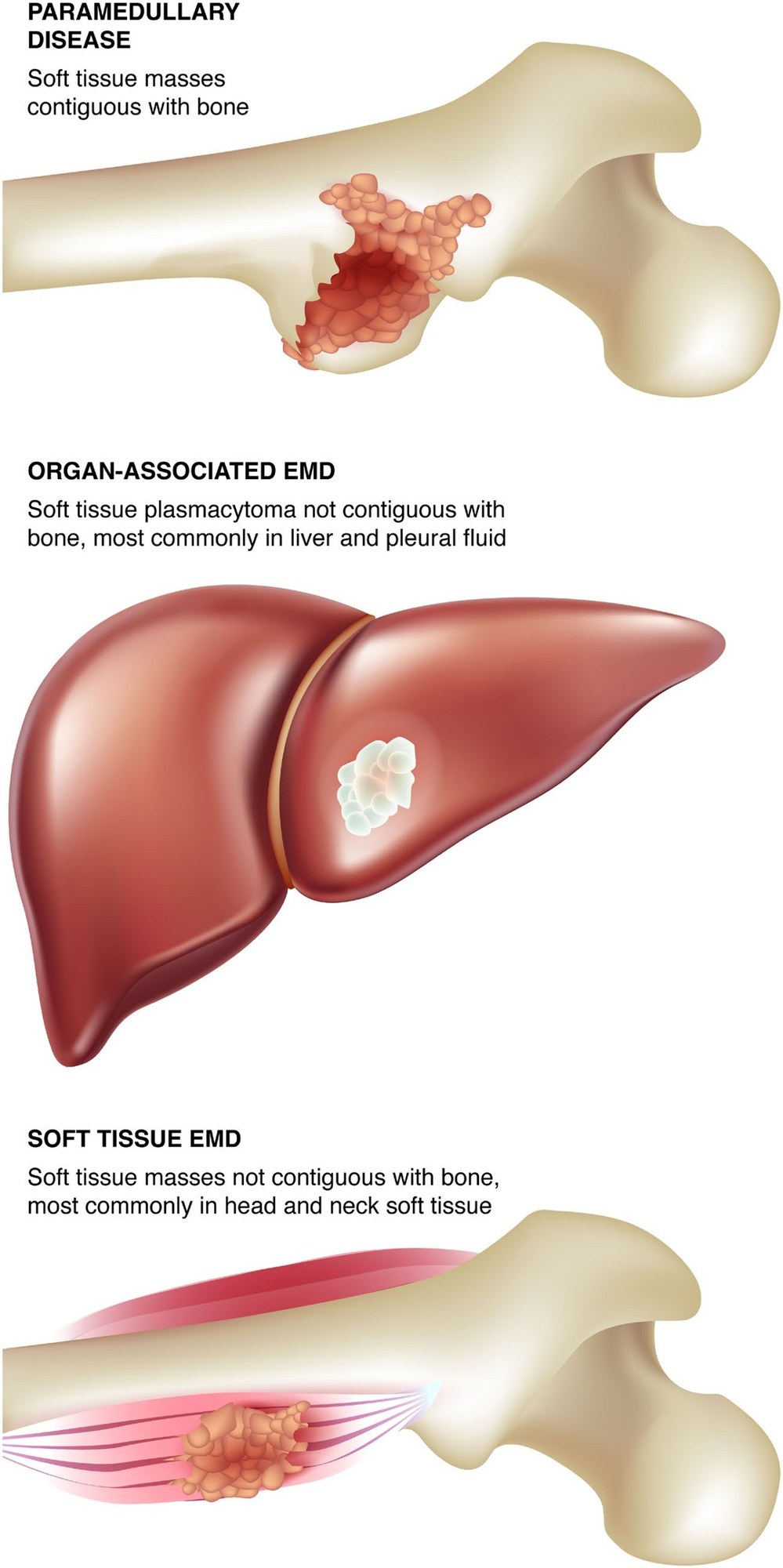
🔬 What is extramedullary disease in myeloma?
Extramedullary disease is an aggressive condition in which malignant plasma cells migrate outside the bone marrow and form tumors in soft tissues or organs. It is one of the most challenging manifestations of myeloma, often resistant to therapy and associated with an unfavorable prognosis.
🩺 Key forms:
- Paramedullary involvement — the tumor is adjacent to the bone, destroying the cortical layer ⚠️
- True extramedullary disease — plasmacytomas are completely independent of the bone and are located in soft tissues, organs, and the central nervous system 💀
- Plasma cell leukemia — a significant number of plasma cells circulate in the blood 🩸
📈 Epidemiology:
At the time of diagnosis, true extramedullary disease is rare (0.5–5.2%), but its frequency increases to 5–30% upon relapse. With the introduction of modern imaging methods, it is detected more often.
🧬 Why does it occur? Development is associated with complex biological mechanisms:
- Loss of adhesion molecules (e.g., CXCR4), allowing cells to migrate from the bone marrow
- Genetic changes: 17p deletion, 1q amplification, mutations in the MAPK pathway (KRAS, NRAS, BRAF)
- Alteration of the tumor microenvironment, resembling solid neoplasms
- Spatial heterogeneity and decreased expression of target antigens (CD38, BCMA)
🖥️ Diagnosis: The main methods are positron emission tomography combined with computed tomography and whole-body magnetic resonance imaging. Biopsy confirms the diagnosis. An increase in serum lactate dehydrogenase levels is often noted.
📊 Prognosis: The presence of true extramedullary disease is a significant negative prognostic factor. The median overall survival after its development is less than 2–3 years. Prognosis is influenced by:
- Secondary occurrence (at relapse)
- Multiple organ involvement
- Central nervous system involvement
- Poor response to therapy
💊 Treatment approaches: Traditional regimens (immunomodulators, proteasome inhibitors, monoclonal antibodies) are often insufficiently effective. Promising approaches include:
- Bispecific antibodies (targeting BCMA, GPRC5D)
- CAR T-cell therapy
- Combinations with chemotherapy (e.g., Dara-PACE, Dara-DCEP)
- Tandem autologous transplantation in selected patients
Prospective studies specifically dedicated to true extramedullary disease are needed to develop optimal treatment strategies.
Source: Kumar S., Usmani S.Z., Richter J. et al. Extramedullary Disease—Achilles Heel in Myeloma? American Journal of Hematology. 2025.


