

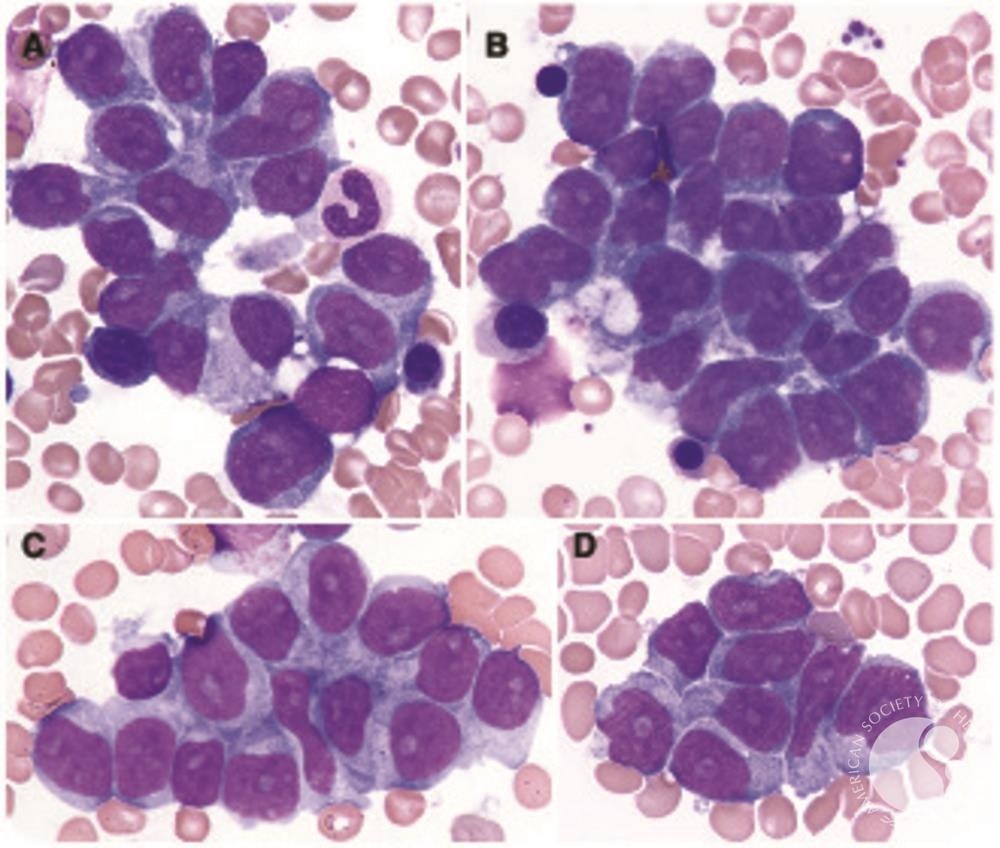
🔬 Hepatosplenic T-cell lymphoma mimicking bone marrow metastases. A clinical case.
✅ A 22-year-old man with no significant medical history presented with complaints of sweating and fatigue. 🩸 Examination revealed hepatosplenomegaly with moderate isolated thrombocytopenia (107 × 109/L). The white blood cell count was 8.5 × 10⁹/L, with no abnormal circulating cells, and hemoglobin level was 131 g/L. Other biochemical analyses were normal, except for an elevated lactate dehydrogenase level (835 IU/L, normal <250 IU/L). 🦴 Bone marrow aspirate showed infiltration by monomorphic medium to large-sized cells, which most often aggregated in clusters rather than being isolated. The cells had regular and irregular nuclear contours; intermediate chromatin, sometimes blastic with prominent nucleoli; and a small to moderately abundant amount of basophilic cytoplasm (photos A-D below). This cytomorphological appearance was consistent with metastatic cells. ❗However, immunophenotypic analysis showed that these cells belonged to the T-cell lineage, demonstrating expression of γ-δ T-cell receptors with CD3, CD2, CD56, CD16, CD11b, and weak expression of CD7, but no expression of CD5, CD4, or CD8. Bone marrow biopsy examination showed only intrasinusoidal involvement by these lymphoma cells, which were positive for T-cell intracellular antigen-1 but negative for granzyme B and perforin. The karyotype was normal. Molecular study detected a γ-δ T-cell clone. An unusual presentation of hepatosplenic T-cell lymphoma mimicking bone marrow metastases. ✅ Source: imagebank.hematology. 👉The prognosis of the disease is unfavorable. The median overall survival is 12 months.
💎Libraries of Blood and Bone Marrow Secrets - over 20 gigabytes! More than 50 videos, over 50 selected books, and 2000 microscopy photos in hematology!


