

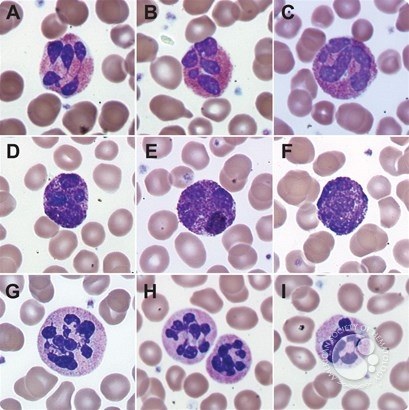
Hypersegmentation of neutrophil, eosinophil, and basophil nuclei due to hydroxycarbamide (hydroxyurea) exposure.
The patient is a 72-year-old man who was diagnosed with polycythemia vera (PV) in 2010. A JAK2 V617F mutation was identified. Treatment with hydroxycarbamide (hydroxyurea) was initiated at a dose of 500 mg, which was gradually increased to 1250 mg per day. The results of the latest complete blood count showed the following: white blood cell count — 11.5 × 10⁹/L; red blood cell count — 3.55 × 10¹²/L; hemoglobin — 13 g/dL; hematocrit — 37.8%; mean corpuscular volume — 106.5 fL; platelets — 423 × 10⁹/L. Examination of the peripheral blood smear revealed 5% circulating blast cells (not shown), macrocytosis, and marked megaloblastic changes in leukocytes. Interestingly, nuclear hypersegmentation was identified in eosinophils (panels AC), basophils (panels DF), and neutrophils (panels GI). Hydroxyurea inhibits DNA synthesis by reducing the enzymatic activity of ribonucleotide reductase and is a primary cytoreductive agent in pemphigoid. Author: Xiangdong Xu Category: Myeloid Neoplasms and Acute Leukemia (WHO, 2016) > Myeloproliferative Neoplasms (MPN) > Polycythemia Vera (PV) Publication Date: 28.08.2014
Photo source: ASH image bank


