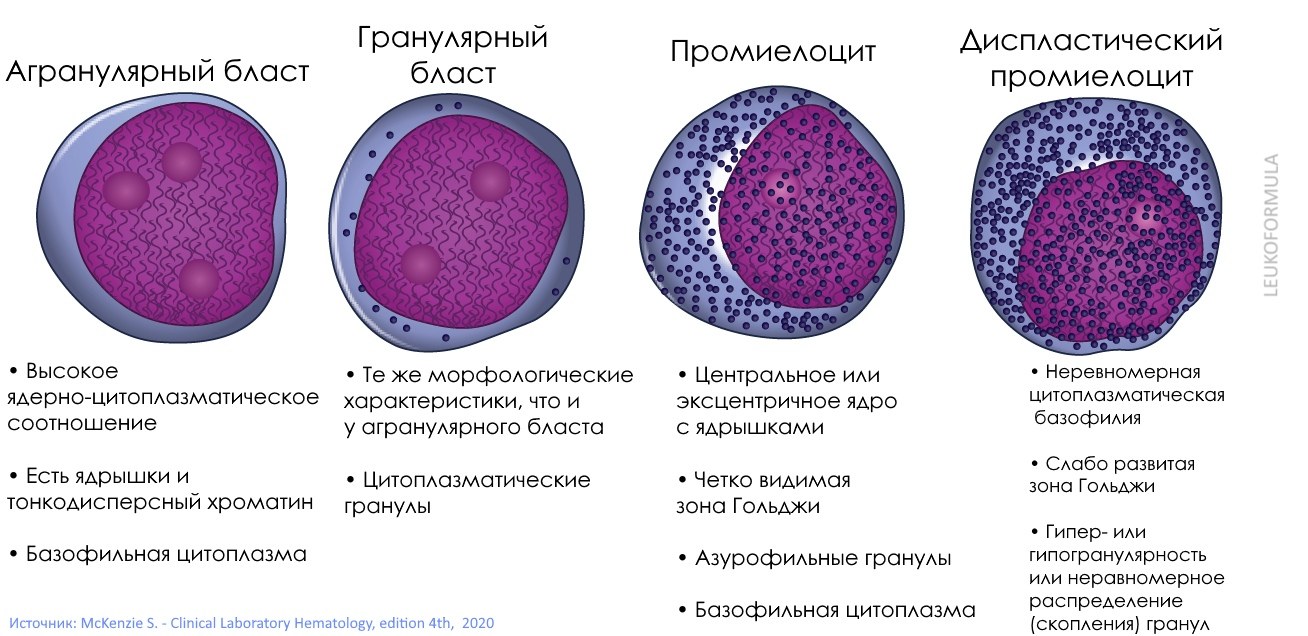
🔬GRANULAR BLASTS OR DYSPLASTIC PROMYELOCYTES? ⚠Classification complexity! ✅Promyelocytes share many features with granular blasts, including small azurophilic cytoplasmic granules. ✅The IWGM-MDS (International Working Group on Morphology of Myelodysplastic Syndrome) determined that the distinguishing feature between the two cells is the presence of a distinct perinuclear clear zone (Golgi complex) observed in promyelocytes. ✅Promyelocytes in MDS can exhibit dysplasia, which may complicate the morphological differentiation of granular blasts and promyelocytes. Dysplastic promyelocytes differ from normal promyelocytes in that their chromatin can vary from finely dispersed to coarse, and azurophilic granularity can have varying intensity and distribution. Also, their Golgi complex may be poorly visible! Source: McKenzie S. - Clinical Laboratory Hematology, 4th edition, 2020
Granular Blasts vs. Dysplastic Promyelocytes in MDS Morphology
IWGM-MDS criteria for differentiating granular blasts and dysplastic promyelocytes: evaluating the Golgi zone, chromatin, and granularity.