

🎓 Clinical Lecture: Modern Standards for Bone Marrow Examination
Bone marrow examination remains the “gold standard” in the diagnosis, classification, and monitoring of hematolymphoid neoplasms. The International Council for Standardization in Hematology (ICSH) has presented updated guidelines that adapt classical methods to the capabilities of modern medicine. 🔬
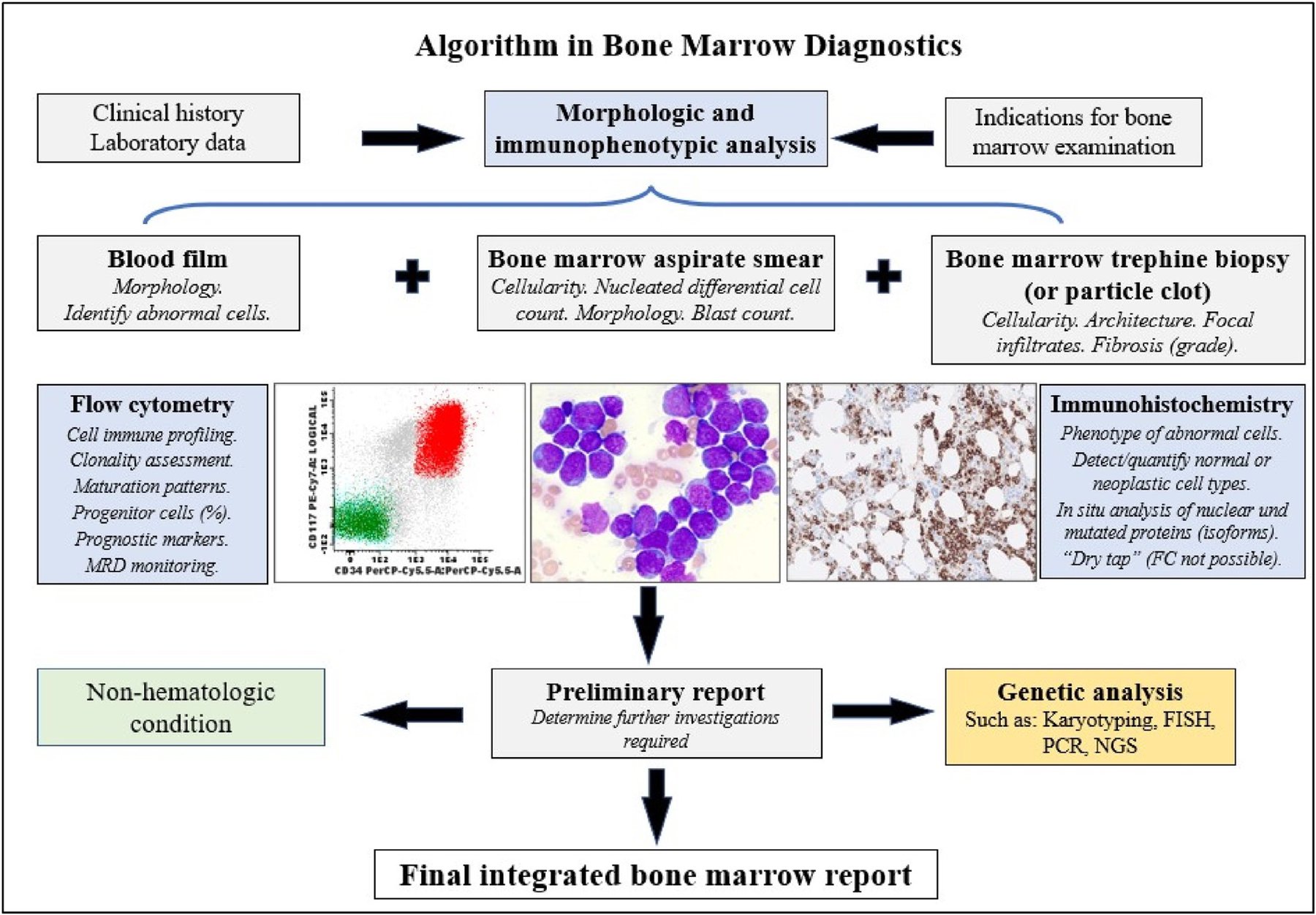
🧬 Comprehensive Approach — The Basis of Diagnosis Modern diagnostics no longer rely solely on microscopy. Optimal results are achieved through the integration of four areas:
- Morphological analysis (aspirate and trephine biopsy).
- Flow cytometry (immunophenotyping).
- Cytogenetic studies (karyotyping).
- Molecular genetic testing.
🧪 Aspirate vs. Trephine Biopsy: What’s the Difference? These two samples complement each other, and their simultaneous collection is critically important for a complete picture:
🔹 Bone Marrow Aspirate (cytology): Allows for detailed study of individual cell structure, evaluation of hematopoietic lineage maturation processes, and blast cell percentage counting. The first portion of the aspirate (“first pull”) is the most valuable, as it is minimally diluted with peripheral blood. It is precisely this portion that is sent for immunophenotyping and genetics. 💉
🔹 Trephine Biopsy (histology): Provides information on tissue architecture, overall cellularity, and spatial distribution of cells. It is the only reliable way to assess the degree of bone marrow fibrosis and identify focal infiltrates that may be missed during aspiration. 🦴
📊 The Role of Immunophenotyping Flow cytometry is indispensable for: Determining lineage in acute leukemias. Detecting minimal residual disease (MRD). Searching for aberrant antigens in myelodysplastic neoplasms.
📈 Integrated Report The main innovation of the guidelines is the emphasis on a single conclusion. The hematologist should receive not fragmented reports from different laboratories, but a synthesized report where morphological data are correlated with genetic markers. This allows for establishing an accurate diagnosis according to current international classifications and determining the disease prognosis. 📑
🤖 The Future of Diagnostics Automated digital microscopy and computational decision support algorithms are actively developing. Although they are still undergoing evaluation, their implementation promises to increase result reproducibility and reduce the influence of subjective factors in cell counting.
Source for citation: Erber WN, Saft L, Matsushita H, Tzankov A, Pozdnyakova O, Zini G. ICSH Guidance on Bone Marrow Examination and Reporting. International Journal of Laboratory Hematology. 2026;0:1–25. DOWNLOAD PDF


