

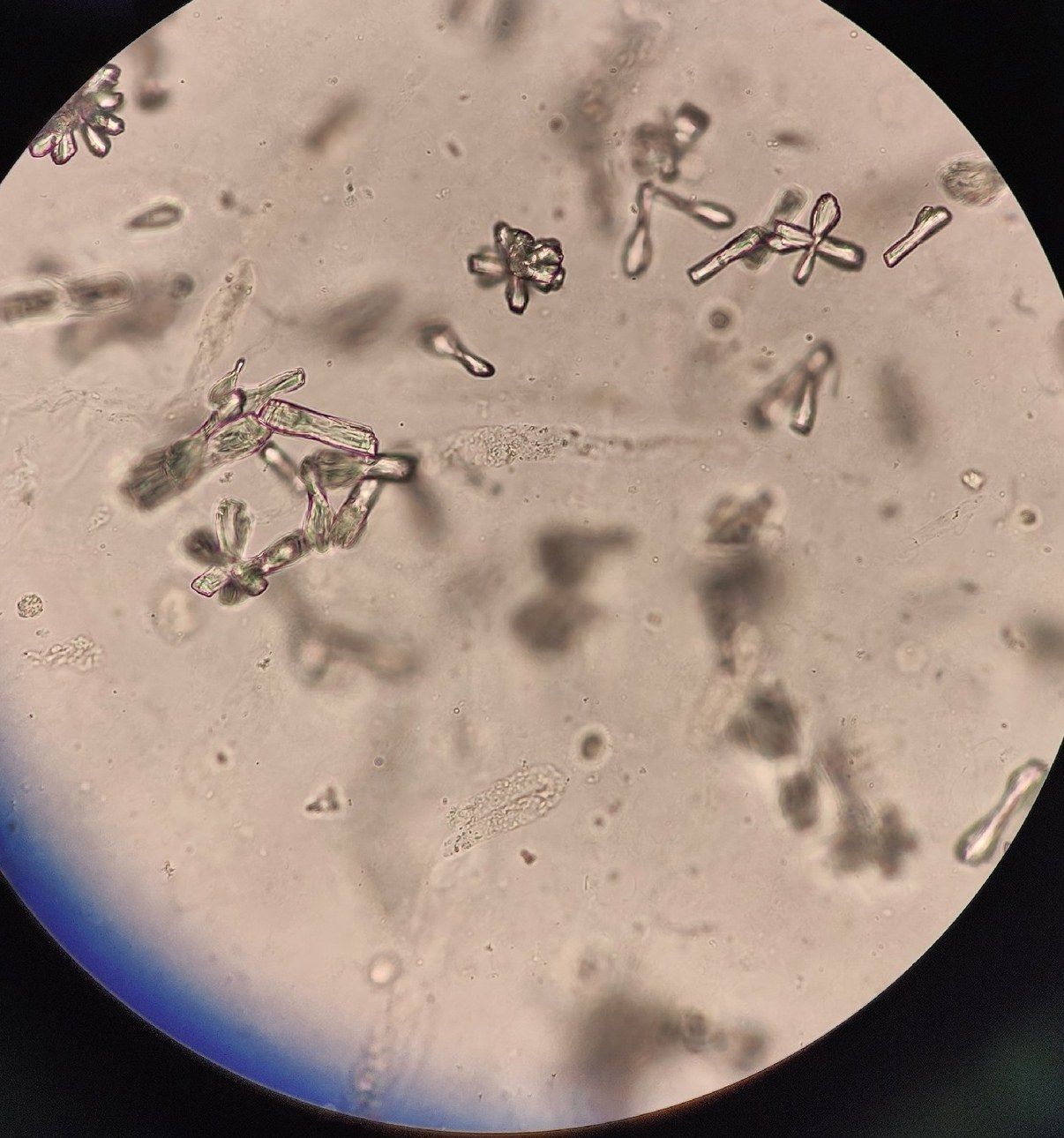
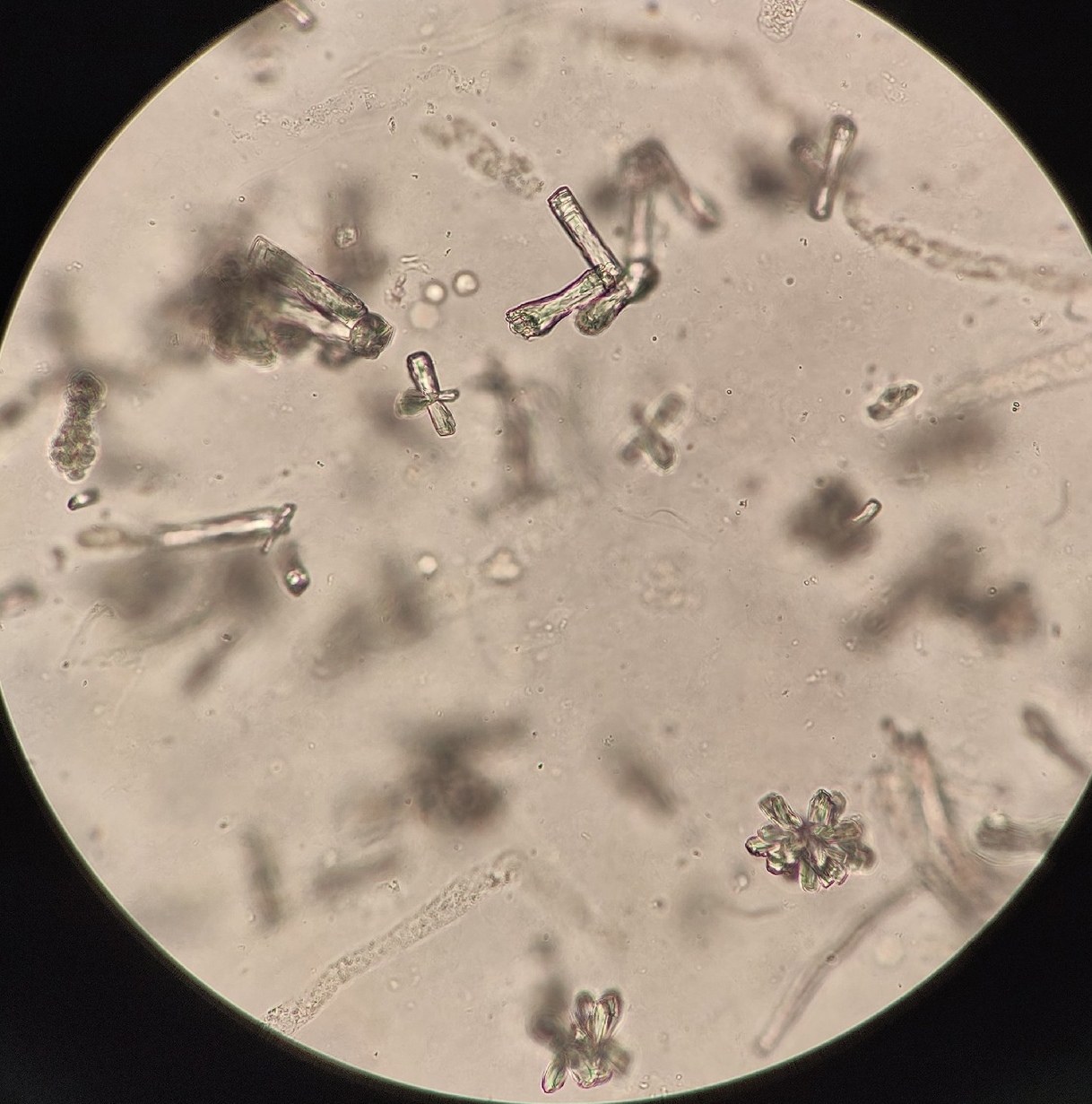
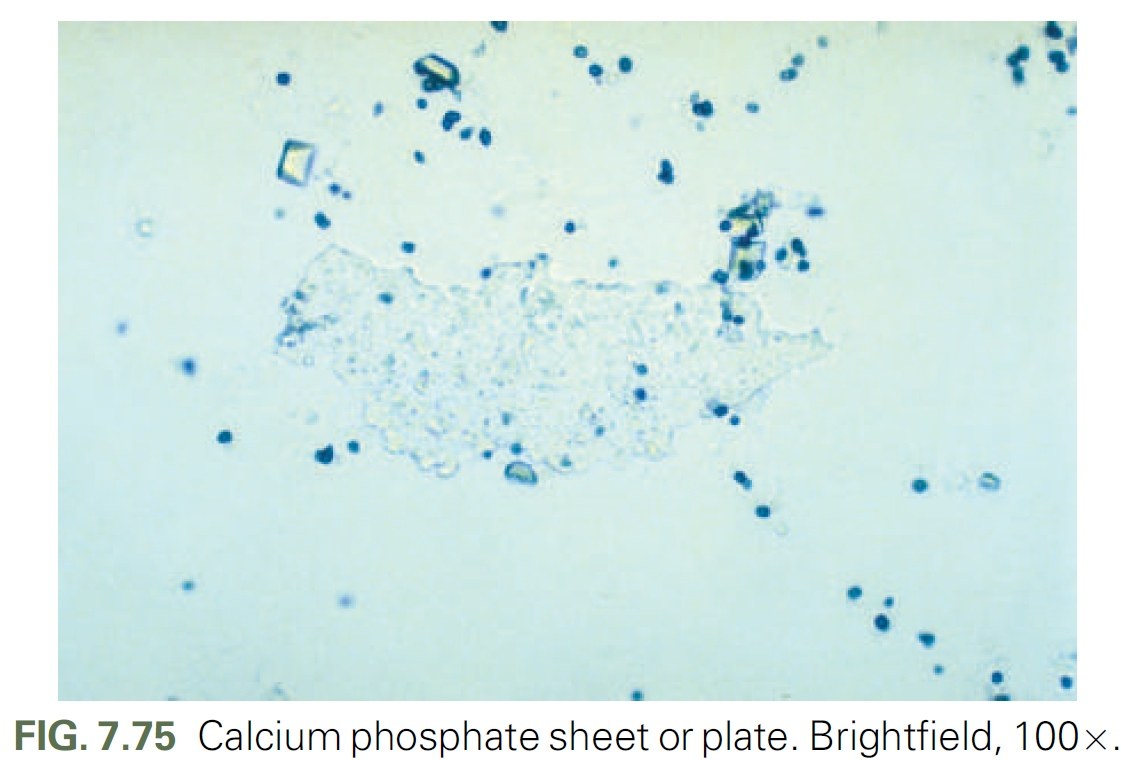
🔬Urinalysis. Calcium phosphate (phosphoric acid lime).
👉Many thanks to Tatyana Zhuleva for the unique photos 1 and 2!
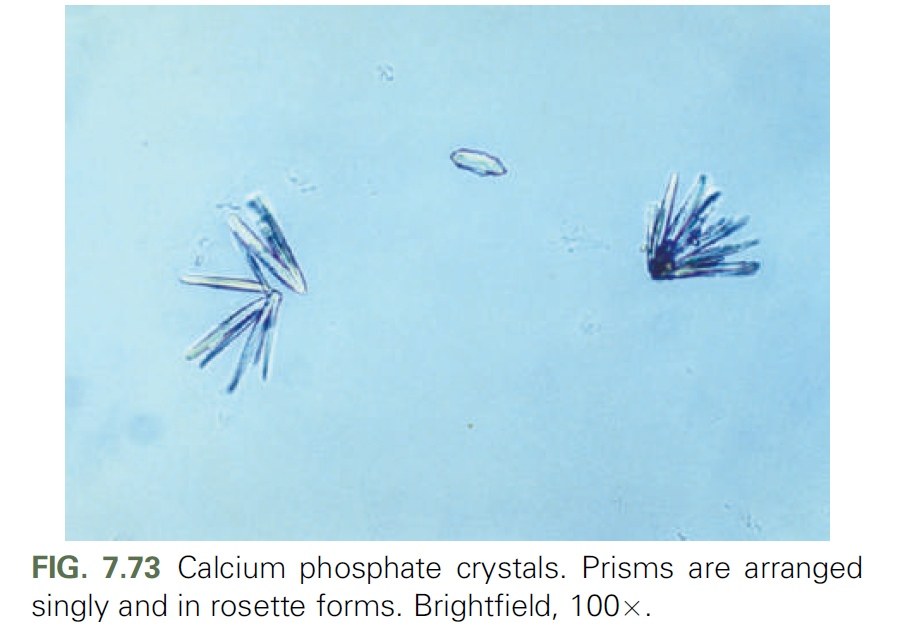
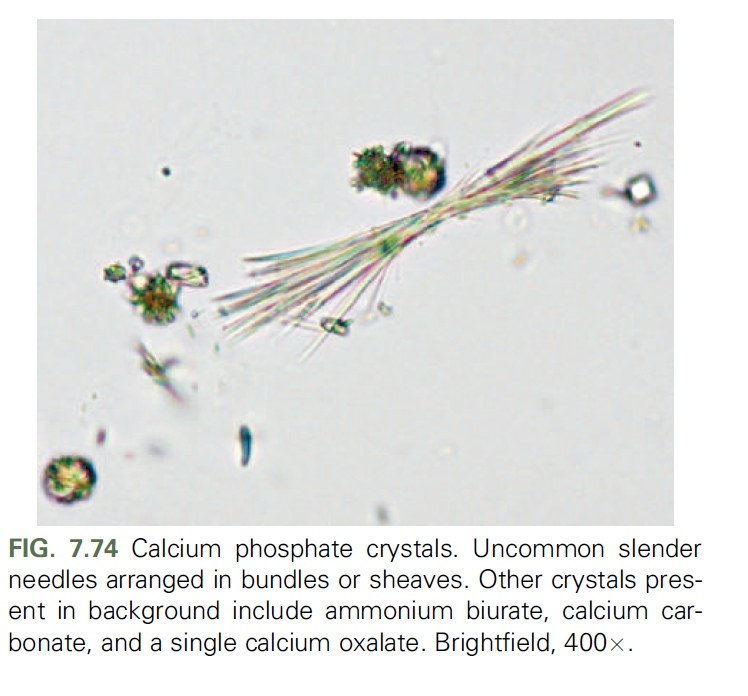
✅Calcium phosphate. Calcium phosphate is present in urine as dibasic calcium phosphate (i.e., CaHPO4, calcium monohydrogen phosphate) and as monobasic calcium phosphate (i.e., Ca[H2PO4]2, calcium dihydrogen phosphate). These similar but different compounds precipitate from solution in distinctly different crystalline forms. Dibasic calcium phosphate crystals, sometimes called stellar phosphates, appear as colorless, thin, wedge-shaped prisms arranged in small groups or as rosettes (photo 3). Each prism has one conical or pointed end and another rounded end. Another, less common form of dibasic calcium phosphate consists of crystals in the form of thin, long needles, gathered into bundles or sheaves (photo 4). In contrast, monobasic calcium phosphate crystals usually appear under the microscope as irregularly shaped granular sheets (photo 5) or flat plates, which can be large and may be seen floating on top of the urine sample. These colorless crystalline plates may resemble large degenerating squamous epithelial cells. Classified as alkaline crystals because they are typically present in neutral or slightly alkaline urine samples, calcium phosphate crystals can also form in slightly acidic urine. They are weakly birefringent under polarizing microscopy. Calcium phosphate crystals are common and have no clinical significance. 👉Source: Nancy A. Brunzel - Urine and Body Fluids Analysis 2018
✅Additionally: attached are 3 pages about this salt from the Atlas of Urine Sediments - 2003, by Mironova I.I.


