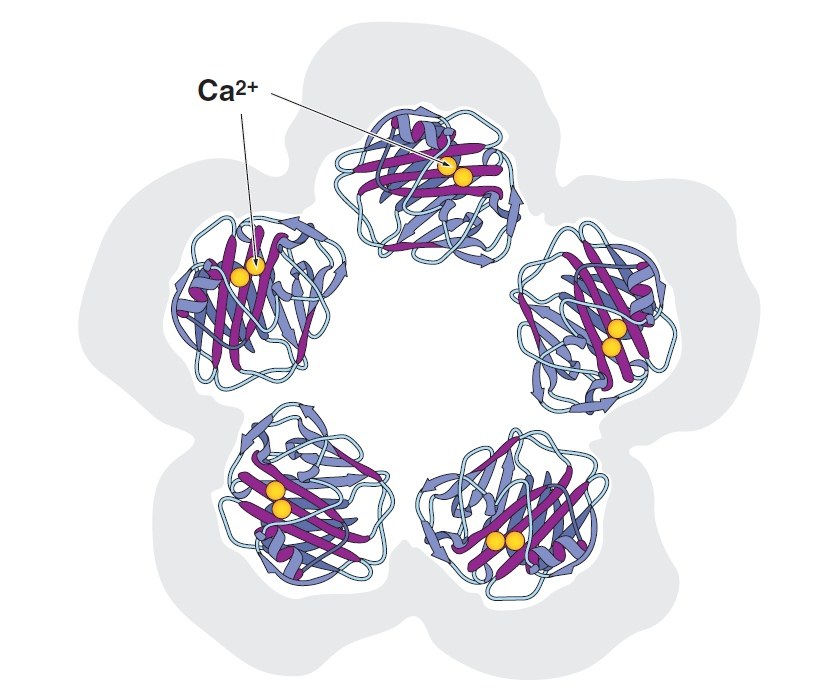
STRUCTURE OF C-REACTIVE PROTEIN. The structure of C-reactive protein, a representative of the pentraxin family. Five domains are joined by non-covalent bonds into an annular structure and form the C-reactive protein molecule. Ligand-binding sites each contain 2 calcium ions. Pentraxins are characterized by their ability to bind to a wide variety of molecules. C-reactive protein was first identified by its ability to bind C-polysaccharide (Streptococcus pneumoniae), which determined its name. Pentraxins also interact with many other molecules: C1q, bacterial polysaccharides, phosphorylcholine, histones, DNA, polyelectrolytes, cytokines, extracellular matrix proteins, serum lipoproteins, complement components, each other, as well as Ca2+ and other metal ions. For all pentraxins considered, there are high-affinity receptors on myeloid, lymphoid, epithelial, and other cells. In addition, this group of acute phase proteins has a sufficiently high affinity for receptors such as FcγRI and FcγRII. Source: Yarilin A.A. - Immunology, textbook, 2010.
Molecular Structure and Functions of C-Reactive Protein
Features of C-reactive protein structure as a pentraxin representative: pentameric annular structure, binding of calcium ions and ligands.