

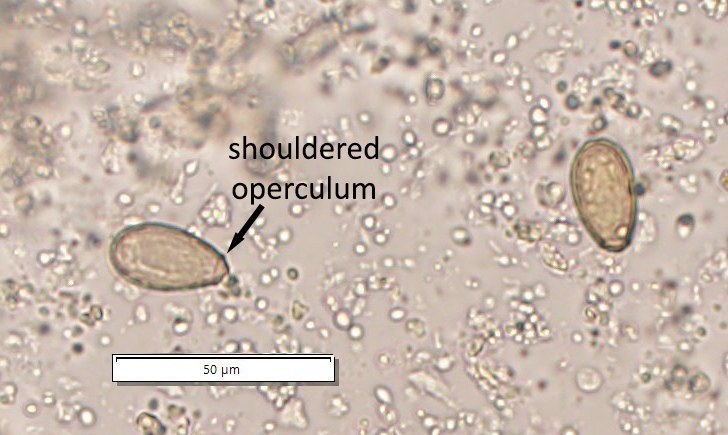
❗Correct answer: Clonorchis sinensis/Opisthorchis eggs. Location (South Korea) is consistent with C. sinensis.
✅Both eggs have an abopercular knob and an obvious operculum. Thus, these could be eggs of either Clonorchis sinensis or Opisthorchis species (both liver flukes). We can likely narrow the identification to Clonorchis sinensis, as Korea is an endemic region for this parasite, whereas Opisthorchis viverrini is endemic to Southeast Asia (i.e., Vietnam, Cambodia, Laos, Thailand).
✅Complications can arise from long-term Clonorchis sinensis infections, including cholangiocarcinoma. Other complications include cholangitis, gallstones, cholecystitis, and pancreatitis.
✅In this case, it is important to also evaluate the size of the eggs (approximately 30 µm in length).
✅Eggs of Metagonimus yokogawai and Heterophyes heterophyes also have a similar appearance and should be considered in the differential diagnosis. However, they are not found in South Korea and can be excluded in this case.


