

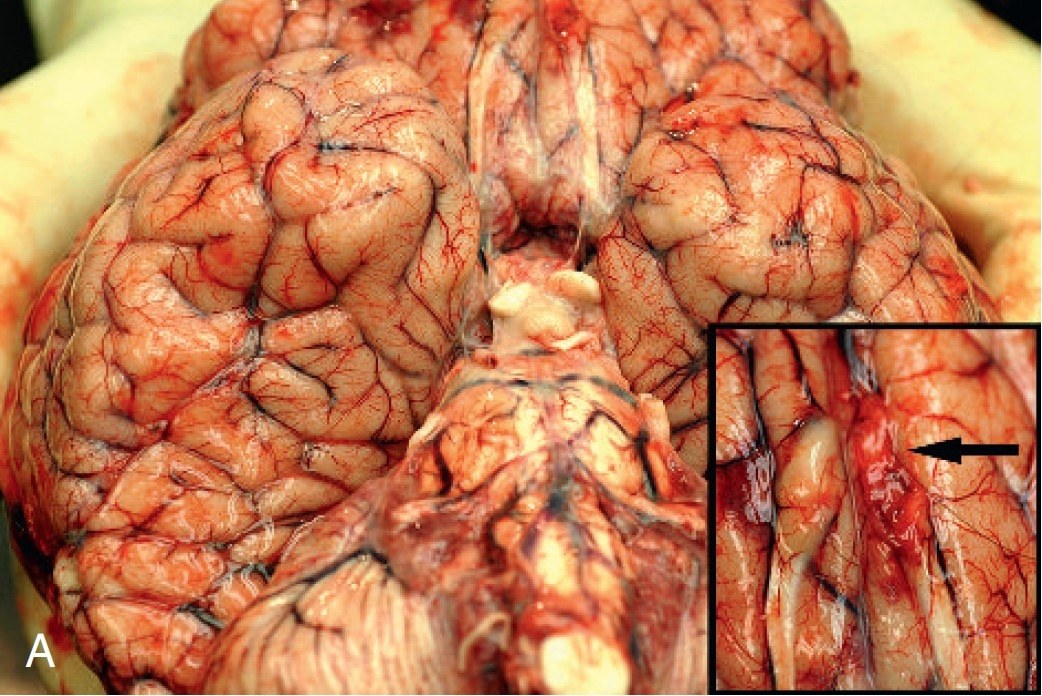
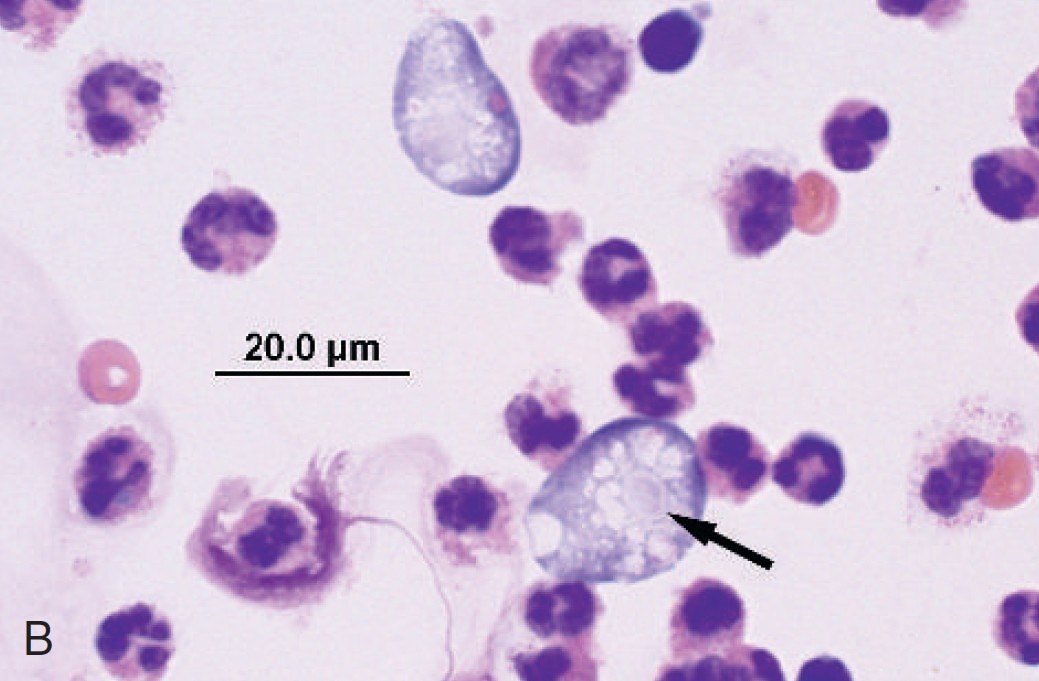
Free-living amoebic infections. (A) Brain of a patient who died from primary amoebic meningoencephalitis caused by Naegleria fowleri infection. Note that the meninges are diffusely hemorrhagic and the left olfactory bulb is obliterated (inset, arrow). (B) Naegleria fowleri trophozoites in cerebrospinal fluid, showing pale-staining vacuolated cytoplasm and a small nucleus with a large central karyosome (arrow). Numerous neutrophils are also present (Giemsa, cytospin preparation, 1000×).
💎 Find more useful parasitology materials in our LAB-TESTS library. The link to access the library is automatically sent to you via private message after paying for a VK Donut Labformula subscription.
Officially in Russian, Naegleria fowleri is called “Negleria Fowlera”. Sometimes the variant “Neigleria Fowlera” is encountered, but “Negleria Fowlera” is considered more common.
This is a free-living amoeba that can cause primary amoebic meningoencephalitis. It usually inhabits warm fresh water (lakes, ponds, swimming pools with insufficient chlorination). When it enters the nasal passages, it can penetrate through the olfactory epithelium to the brain, where it develops rapid inflammation.
Epidemiology: more common in warm regions, especially in summer when water temperature rises. Transmission route: through the nose (most often when diving or inhaling water sharply through the nose). Disease: causes extremely severe and acute meningoencephalitis; symptoms progress very quickly. Prevention: avoid getting warm fresh water into the nose when swimming, use protection (nose clips), or rinse the nose and eyes only with reliably purified (boiled, filtered) water.
In Russia, cases of Naegleria fowleri infection have not been registered. This is due to the fact that the amoeba prefers warm climates and water bodies with water temperatures above 25 °C. Most water bodies in Russia, especially in northern and temperate latitudes, have lower water temperatures, which limits the amoeba’s survival. However, theoretically, its presence is possible in the southern regions of the country (for example, in the North Caucasus or the lower Volga), especially in artificial water bodies with heated water.
Naegleria fowleri is more common in countries with warm climates, as the amoeba prefers warm fresh water. Geographic distribution includes:
Main countries and regions: North America: USA (especially southern states such as Texas, Florida, Arizona). Mexico. South America: Brazil, Argentina, and other regions with hot climates. Australia and Oceania: Australia (cases of infection recorded in lakes and rivers). Asia: India. Pakistan. Southeast Asia (Thailand, Philippines). Africa: Countries with warm climates, especially near the equator. Europe: Cases are extremely rare, but sometimes recorded in southern regions, for example, in Italy or Spain.


