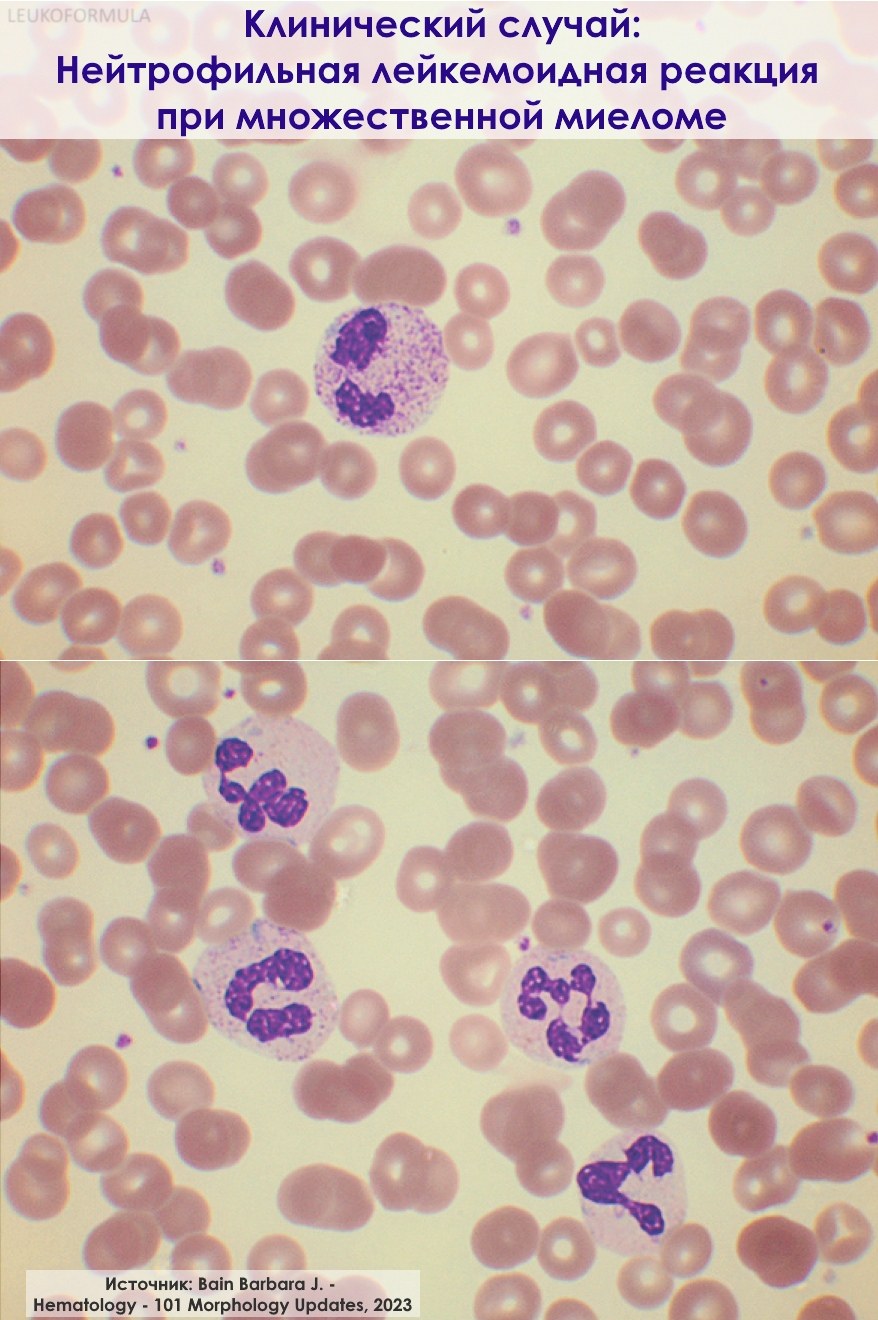
✔Neutrophilic leukemoid reaction in multiple myeloma. ✅A 52-year-old man with asymptomatic multiple myeloma was referred for evaluation of high white blood cell and neutrophil counts. ✅He had already started taking hydroxyurea, and while on this medication at a dose of 2.5 g per day, his white blood cell count was 22.5 × 10⁹/L, and his neutrophil count was 18.9 × 10⁹/L. 🧪He was found to have IgG λ paraprotein at a concentration of 80 g/L. 🔬A blood smear showed toxic granulation and Döhle bodies (photo below), although not all neutrophils were abnormal. Bone marrow aspirate showed 10-15% plasma cells and granulocytic hyperplasia. 🧬Molecular analysis for JAK2 V617F and CSF3R exon 14 and 17 mutations was negative. ✅A diagnosis of neutrophilic leukemoid reaction to multiple myeloma was made. ✅Isolated neutrophilia without dysplasia is characteristic of chronic neutrophilic leukemia (CNL). However, before making this diagnosis, an underlying plasma cell neoplasm must be ruled out. About a quarter of reported patients with either CNL or a condition resembling it had coexisting monoclonal gammopathy of undetermined significance or multiple myeloma. Very rarely, CNL and plasma cell neoplasms can coexist. ✅Patients with multiple myeloma and neutrophilia often have toxic granulation of neutrophils and Döhle bodies, as shown in this patient. ✅Granulocyte colony-stimulating factor (G-CSF) is synthesized by tumor plasma cells. And a high serum G-CSF level indicates that this is a reactive process driven by cytokines. Although similar changes are observed in CNL, in these patients, the cytological changes are likely the result of a mutation that directly affects neutrophil biology, specifically, a mutation in CSFR3, which encodes the G-CSF receptor.
Neutrophilic Leukemoid Reaction in Multiple Myeloma
Clinical case of neutrophilic leukemoid reaction in multiple myeloma: neutrophil morphology, Döhle bodies, and differential diagnosis with CNL.