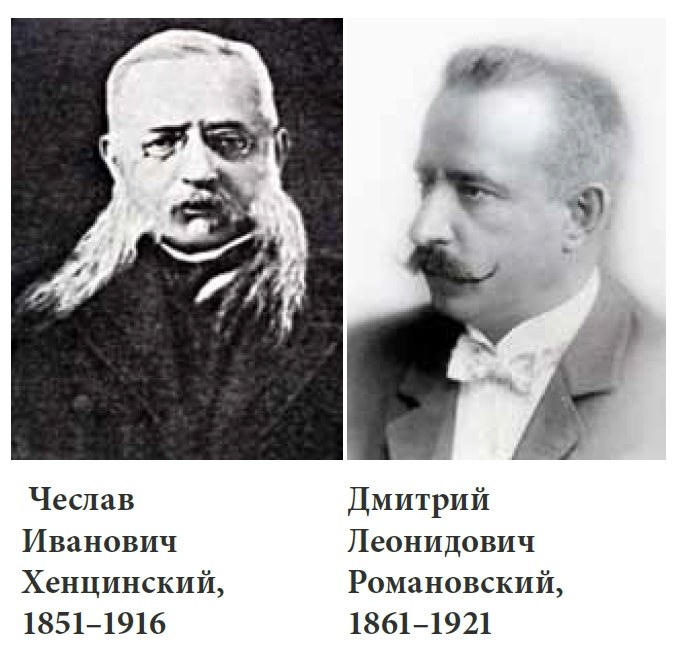
HISTORY OF BLOOD SMEAR STAINING. Our compatriots, military doctors and alumni of the Imperial Medical-Surgical Academy, Cheslav Ivanovich Khentsinsky and Dmitry Leonidovich Romanowsky, made a decisive contribution to the development of blood smear staining. The polychromatic blood smear stain proposed in 1890, using a mixture of azure B, methylene blue, and eosin, has been used worldwide for over 120 years. In 1984, the International Council for Standardization in Haematology (ICSH) Working Group of experts on dyes and staining methods in hematology, composed of the most prominent scientists, concluded: “The Romanowsky staining effect is that the blue cationic dye azure B and the red-orange anionic dye eosin Y, when interacting with biological substrates, produce more colors than just blue and red-orange. Red-purple is the most important color that characterizes the Romanowsky effect,” which finally confirmed the priority of the Russian scientist and physician Dmitry Leonidovich Romanowsky as the creator of the blood cell staining system (Br J Haematol. 1984 Aug; 57 (4): 707–710).
Romanowsky Staining of Blood Smears: Method History
The history of polychromatic blood smear staining: contributions of D. L. Romanowsky and Ch. I. Khentsinsky, mechanism, and ICSH recognition.