

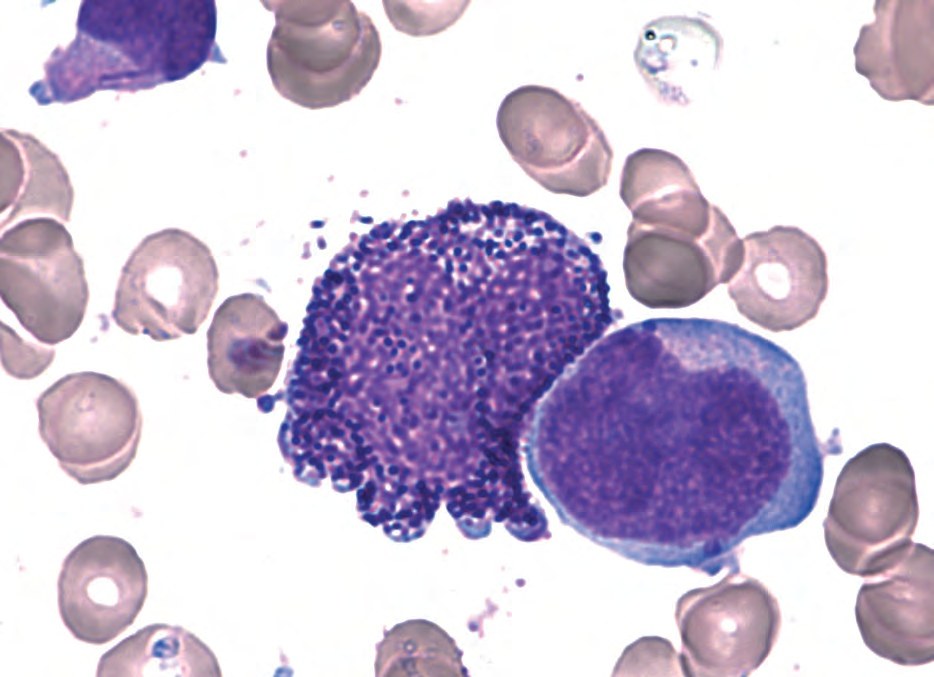
A case of APL (acute promyelocytic leukemia) with not entirely typical morphology; bone marrow aspirate.
In the center is a promyelocyte containing a huge number of dark granules. The granules are clearly distinguishable individually and are distributed throughout the cell, covering both the nucleus, practically erasing its contours, and the cytoplasm. In the lower part, the cytoplasm appears uneven, ragged.
To the right is a cell with intensely basophilic cytoplasm containing small granules, which are especially noticeable in the Golgi zone. Basophilia intensifies at the periphery of the cell.
The nucleus contains granular, predominantly homogeneous chromatin with areas of condensation. In the region below the Golgi zone, there is an indentation of the nucleus, from which, apparently, a longitudinal groove extends, partially dividing the nucleus into two large lobes.
From the upper left corner protrudes approximately half of a small promyelocyte with a small amount of blue and purple cytoplasm, in which there is a long, thick Auer rod.
Key morphological point: this describes APL with unusual morphology, but the presence of numerous azurophilic granules and especially Auer rods supports the promyelocytic nature of the cells. ⭐ Source: Giuseppe d’Onofrio - Morphology of Blood Disorders 2015


