

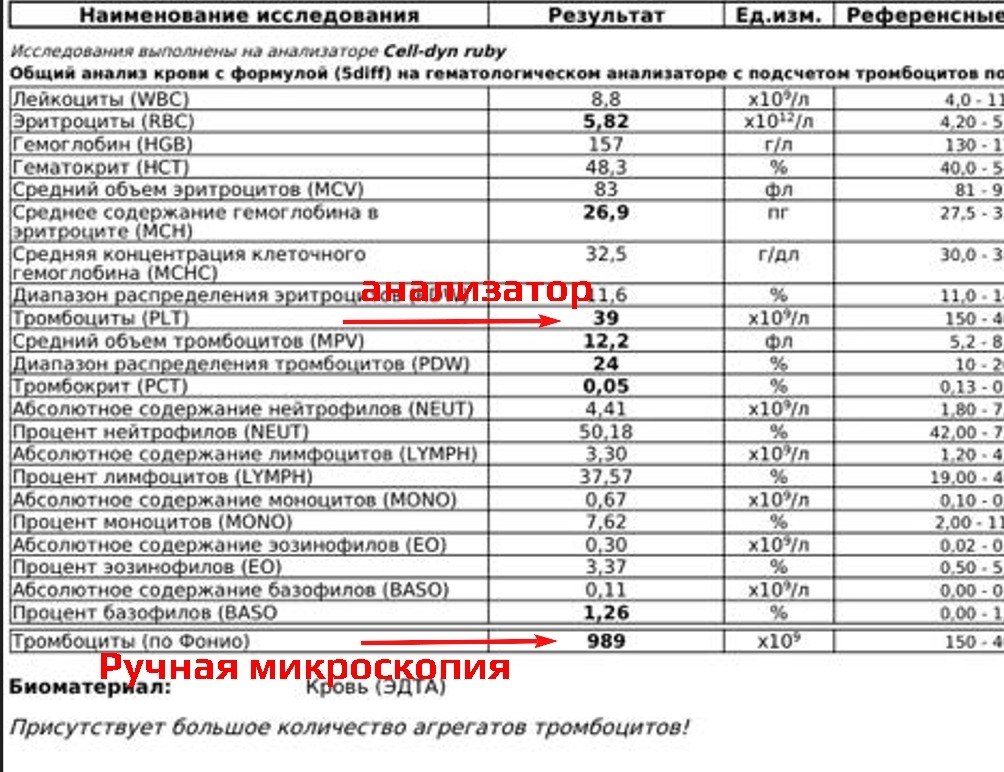

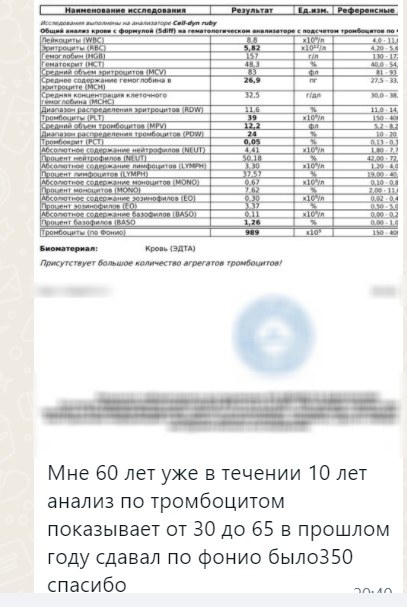
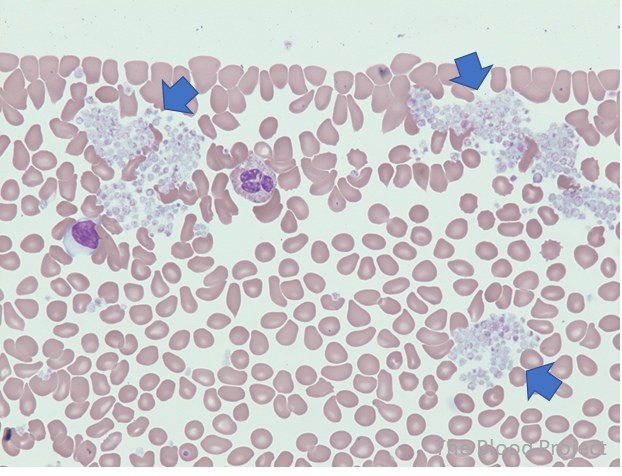

THROMBOCYTOPENIA OR THROMBOCYTOSIS? ANALYZER SHOWED PLATELETS (PLT) - 39, BUT MANUAL METHOD - 989! A 60-year-old man contacted me via WhatsApp for online assistance to interpret his laboratory test results*. He attached a photo of his CBC (photo 1). In the complete blood count, the platelet level was: 📠Analyzer (Cell-Dyn Ruby) - 39 x 103/µL (normal 150-450 x 103/µL). 🔬Manual microscopy (Fonio method) - 989 x 103/µL. ❓The patient asks what his true platelet level is. Does he need treatment or further investigation? ✅ANAMNESIS (photos 2 and 3): For 10 years, his platelet count has ranged from 30 to 65 x 103/µL. Last year, platelets by the Fonio method were 350 x 103/µL. He feels healthy - no complaints. 👨💻REASONING: This case clearly demonstrates the inadequacy of some modern medical institutions in counting platelet levels. Practically, 3000% - the range of deviation between manual and automated analysis. The platelet level by Fonio method in the same tube is 30 times higher than what the analyzer reported. How can this be? What should be treated, the patient’s low platelet count, should glucocorticoids be prescribed? Or should he be investigated for Jak2 V617F myeloproliferative disease mutations (essential thrombocythemia, myelofibrosis) since the platelet level by manual method is >450 x 103/µL? ❗ANSWER. We cannot trust either the analyzer’s result or the manual count result. The analyzer falsely underestimates platelet concentration due to aggregation (there is a comment below that a large number of aggregates are present in the smear). Platelet aggregation, for example, for those who don’t know what it is, is shown in photo 4. Platelet aggregation does not indicate any disease in a person. It is associated with difficulties in blood collection (especially capillary blood collection) or with the influence of the anticoagulant EDTA (mandatory in the tube to keep the blood in a liquid state). More details on EDTA-dependent pseudothrombocytopenia can be found in my archived article: www.leukoformula.com/post/platelets_low 😕I am sure that the doctor who examined the blood smear also made a mistake. The Fonio method for counting platelets is very subjective. If you don’t believe me, ask Professor S.A. Lugovskaya of the Department of Clinical Laboratory Diagnostics, RMAPO, about the Fonio method sometime when you meet her. At almost every conference where a full hall of CLD doctors from all over Russia gathers, she explains that the Fonio method is a relic of the past. With this method of determining the number of platelets, they are counted in microscopic fields of view (per 1000 erythrocytes) and multiplied by the erythrocyte concentration. Large aggregates, like large blood cells (monocytes), due to physical laws, move to the edge of the smear during preparation. And we usually see under the microscope that platelet aggregates are somewhere on the side, and in the center of the smear, there are no platelets at all (they have “stuck together” and moved to the “edge”). It is quite probable that the doctor in the laboratory did not find them in the center and began counting them at the edge of the smear, where there would, of course, be many. The Fonio method is not applicable in cases of platelet aggregation (since the distribution of platelets in the smear is uneven). I ask all doctors and laboratory assistants to understand that when we see platelet aggregation in a smear (even if it’s just 3-5 platelets), a quantitative characteristic for platelets should not be reported. The value in the “platelets” row should be removed, and a comment should be added: “platelet aggregation” and appropriate recommendations given (re-collection into a special tube with citrate or magnesium sulfate). It is also recommended to minimize the transport time of biomaterial to the laboratory, and ideally, to perform the blood test immediately after blood collection. Otherwise, the patient will spend 5 years looking for the cause of thrombocytopenia, and then another 5 years looking for the cause of thrombocytosis! 🙏🏻I also ask all heads of clinical diagnostic laboratories, please introduce a new test in your laboratories: 👉🏻Platelet count in a tube with citrate (or with magnesium sulfate, which is even better). ✅RECOMMENDATIONS: I advised the patient to find a nearby laboratory that would agree to perform a complete (clinical) blood count in a citrate tube (blue-capped tube). The patient did as I asked immediately. He chose the laboratory where they also counted by Fonio. 🔥The platelet level in the citrate tube was 154 x 10^3/µL (photo 5). NORMAL LEVEL! No treatment required. 😊The patient thanked me for my help!
Published with the patient’s permission.


