

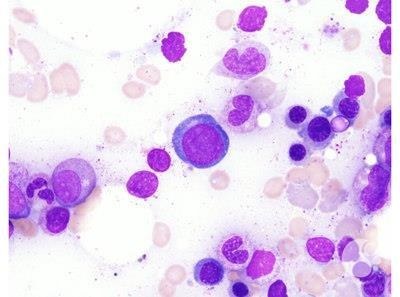
Proerythroblast
- Proerythroblasts (also called pronormoblasts) are the earliest erythroid precursors. They are large cells with basophilic, agranular cytoplasm, round nuclei, and a high nuclear-to-cytoplasmic ratio. Chromatin is evenly distributed but slightly denser than that of myeloblasts. One or more nucleoli may be visible. A perinuclear clear area (HOF) may also be observed. One proerythroblast is visible in the center of the image. Polychromatophilic and orthochromic normoblasts are present in the right part of the field of view.
Author: Teresa Scordino Category: Morphological Variants of Normal Cells > Morphological Variants of Erythrocytes/Precursors > Erythroid Precursors Publication date: 13.01.2016
Photo source: ASH image bank


