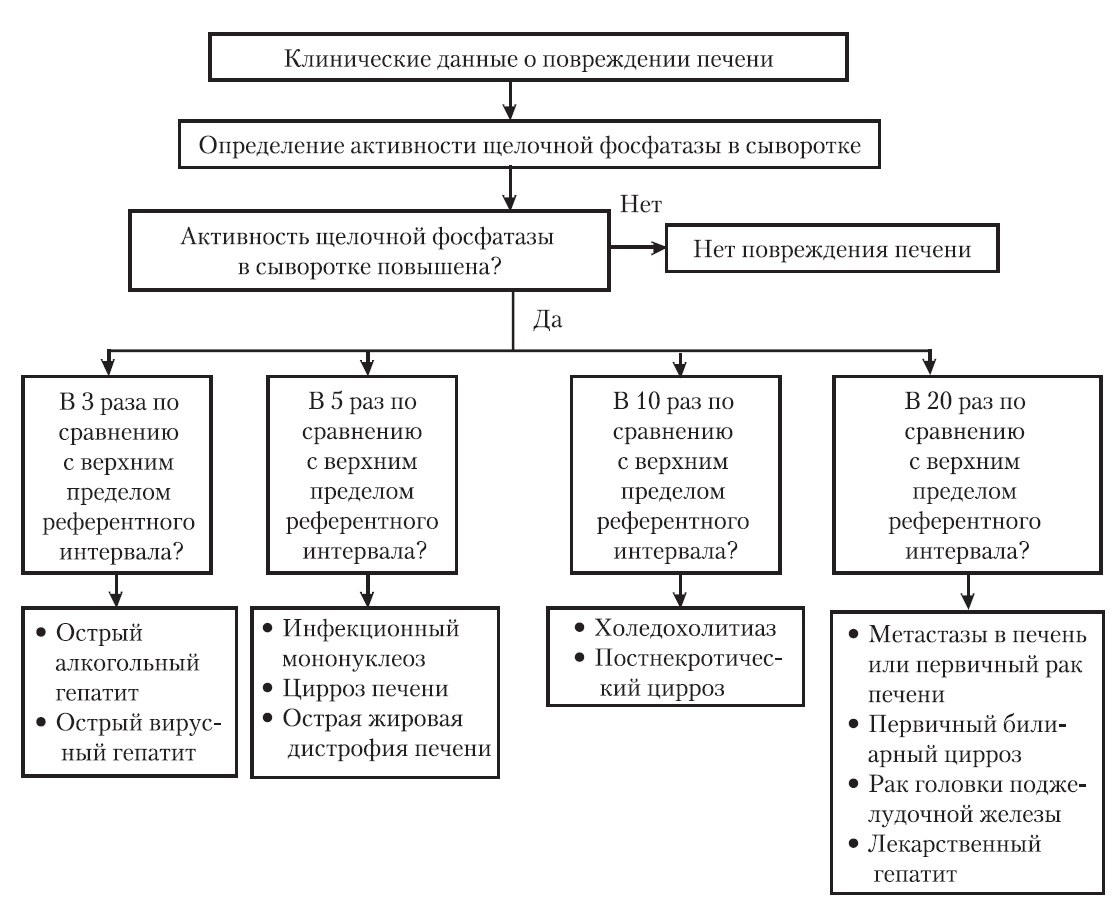
ALGORITHM FOR CLINICAL DECISION-MAKING IN ESTABLISHING THE ETIOLOGY OF LIVER INJURY BASED ON ALKALINE PHOSPHATASE ACTIVITY VALUES. Increased activity of the liver form of phosphatase most often occurs due to damage or destruction of hepatocytes (hepatocellular mechanism) or impaired bile transport (cholestatic mechanism). The hepatocellular mechanism of alkaline phosphatase activity elevation plays a leading role in viral and autoimmune hepatitis, toxic and drug-induced liver damage. Bile outflow is impaired due to extrahepatic obstruction of the bile ducts (e.g., by a stone or due to postoperative stricture development), narrowing of intrahepatic ducts (e.g., in primary sclerosing cholangitis), damage to bile ducts (e.g., in primary biliary cirrhosis), or impaired bile transport at the level of small bile ducts (when using a number of drugs, e.g., chlorpromazine). In some cases, alkaline phosphatase activity increases due to the simultaneous action of both damage mechanisms. The increase in alkaline phosphatase activity in liver damage occurs due to its release from hepatocytes. Alkaline phosphatase activity in viral hepatitis, in contrast to aminotransferases, remains normal or increases slightly. An increase in alkaline phosphatase activity is also found in jaundiced patients with cirrhosis (in one-third of cases). Approximately half of patients with infectious mononucleosis also show increased alkaline phosphatase activity in the first week of the disease. A significant increase in alkaline phosphatase activity is observed in cholestasis. Extrahepatic bile duct obstruction is accompanied by a sharp increase in enzyme activity. Elevated alkaline phosphatase activity is observed in 90% of patients with primary liver cancer and liver metastases. Its activity sharply increases in alcohol poisoning against the background of alcoholism. It can increase with the intake of drugs with hepatotoxic effects (tetracycline, paracetamol, mercaptopurine, salicylates, etc.). Cholestatic jaundice and, accordingly, increased alkaline phosphatase activity are possible in women taking oral contraceptives containing estrogens and progesterone. According to various authors, only approximately 65% of hospitalized patients with high alkaline phosphatase activity have liver diseases. Very high enzyme activity is observed in women with preeclampsia, which is associated with placental damage. Decreased alkaline phosphatase activity in pregnant women may indicate insufficient placental development. In addition to the mentioned causes, increased alkaline phosphatase activity is detected in the following diseases and conditions: increased bone metabolism (during fracture healing), primary and secondary hyperparathyroidism, osteomalacia, renal rickets, cytomegalovirus infection (CMV infection) in children, sepsis, ulcerative colitis, regional ileitis, intestinal bacterial infections, thyrotoxicosis. This is due to the fact that alkaline phosphatase is produced not only in the liver but also in other organs – bones, intestines. Values of alkaline phosphatase activity (thresholds for clinical decision-making) in establishing a clinical diagnosis of liver injury are presented in the photograph below [Menshikov V.V., 2002]. A number of values are multipliers by which the upper reference limit for alkaline phosphatase is multiplied. Source: Guide to Laboratory Diagnostic Methods, A.A. Kishkun. 2007
Alkaline Phosphatase in Liver Injury: An Assessment Algorithm
Causes of elevated alkaline phosphatase in hepatitis, cholestasis, and liver tumors. Differential diagnosis algorithm based on enzyme elevation levels.