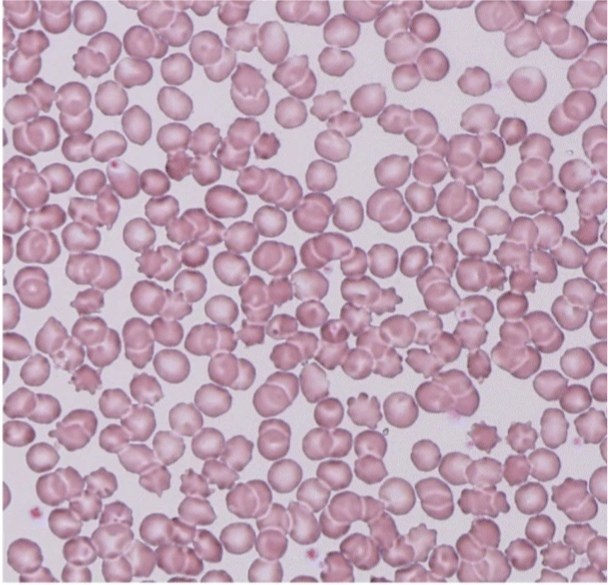
MCLEOD SYNDROME Only about 150 cases have been reported worldwide. People with this condition have abnormally star-shaped red blood cells – acanthocytosis. It is clinically characterized by a Huntington’s disease-like phenotype with involuntary hyperkinetic movement disorder, psychiatric manifestations, and cognitive impairment, and biochemically by the absence of Kx antigen and weak expression of Kell antigens. Signs and symptoms of the syndrome usually begin in mid-adulthood. Currently, there is no treatment to prevent or slow the progression of McLeod syndrome. Treatment is symptomatic. In the photo: erythrocyte acanthocytosis in a peripheral blood smear (Murakami, T., Abe, D., Matsumoto, H. et al. A patient with McLeod syndrome showing involvement of the central sensorimotor tracts for the legs. BMC Neurol, 2019)
McLeod Syndrome: Acanthocytosis in Peripheral Blood Smear
McLeod syndrome is a rare genetic disorder with neuroacanthocytosis. Learn about erythrocyte morphology in blood smears, Kx antigen deficiency, and clinical features.