

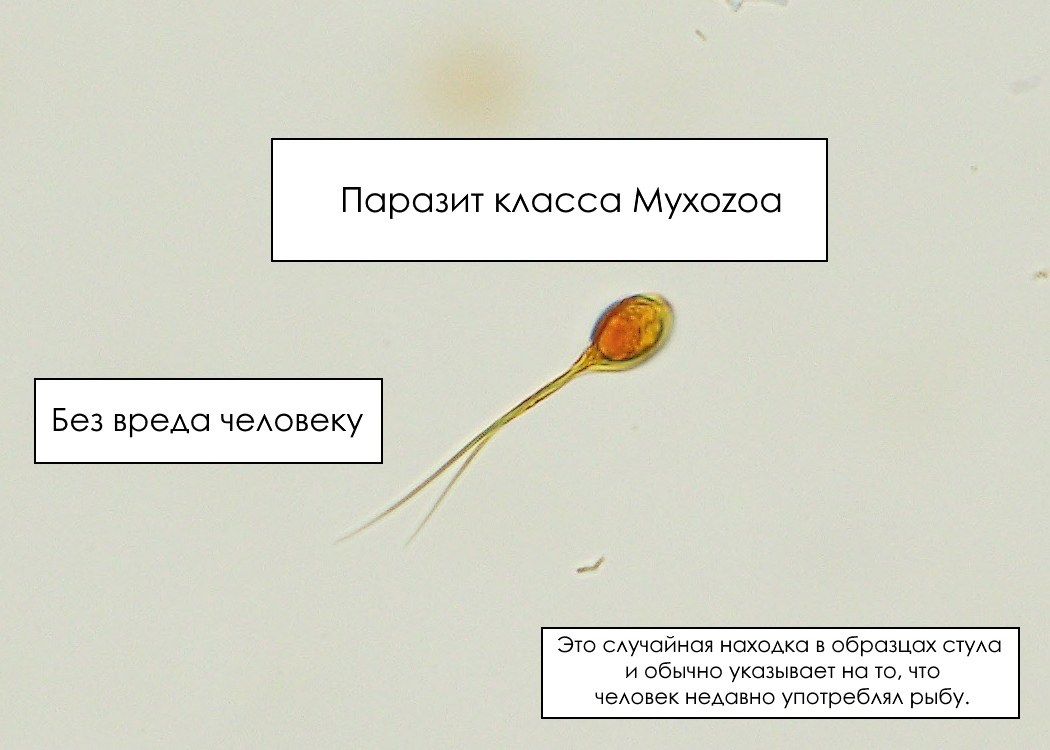
❗Correct answer to the problem: These are spores of a Myxozoa class parasite. It parasitizes fish. ✅ This is an incidental finding in human stool samples and usually indicates that the person recently consumed fish, such as salmon. Laboratory physicians (especially in forensic medicine) should be aware of this, as there is a very real possibility of mistaking these structures for human spermatozoa. This is particularly important when considering cases involving children and suspected sexual abuse. These structures can be distinguished from human spermatozoa by the consistent presence of two caudal appendages (rather than a single tail in spermatozoa; which only rarely have two tails), a larger head structure with two polar capsules, and a longer tail relative to the head. Spermatozoa also have a more pronounced neck. Unfortunately, the appearance can be very similar, so collecting a dietary history can also be useful.
✅ We also recommend reading the article: McClelland, R. S., D. M. Murphy, and D. K. Cone. “Report of Spores of Henneguya Salminicola (Myxozoa) in Human Stool Specimens: Possible Source of Confusion with Human Spermatozoa.” Journal of Clinical Microbiology 35.11 (1997): 2815-818. You can download it below in PDF format.
💎 Find even more useful materials on stool examination in our LAB-TESTS library. The link with access to the library is automatically sent to you via private message after paying for a VK donut Labformula subscription.


