

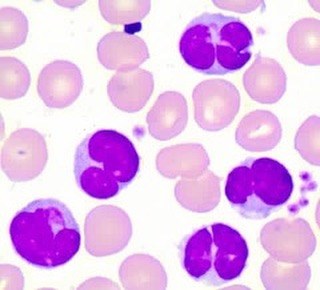
Adult T-Cell Lymphoma/Leukemia
A 36-year-old patient with severe skin lesions was observed by several dermatologists, but no diagnosis was established. Six months later, a clinical blood test was performed, which revealed 25 percent pleomorphic lymphoid cells with convoluted nuclear contours; some cells had a flower-like cell morphology, characteristic of adult T-cell lymphoma/leukemia. The diagnosis was confirmed by immunophenotyping.
Adult T-cell lymphoma/leukemia was first described in Japan. The disease is associated with human T-lymphotropic virus type 1 and also occurs in the United States of America, Caribbean countries, and Brazil. The acute form is highly aggressive, characterized by leukemic transformation and generalized lymphadenopathy; the median overall survival is usually less than two years.
In most cases, skin involvement is noted, typically with pronounced epitheliotropism. The morphology of tumor cells is variable: lymphoid cells can be small with dense nuclei or large, atypical, with hyperlobulated pleomorphic and convoluted nuclei, including flower-like cells.
🔬 Source: from the archive of Brazilian hematology specialist Marcio Melo


