

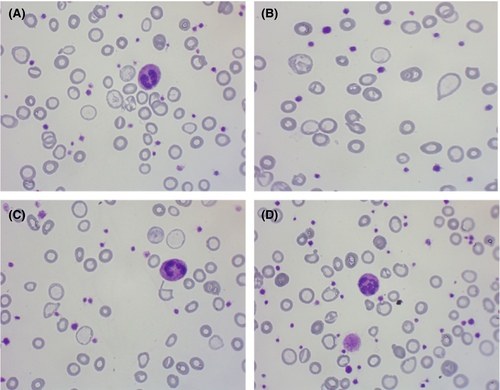
From the International Journal of Laboratory Hematology. Extremely severe anemia – worsening of a patient’s condition in the COVID-19 pandemic era. A 52-year-old woman was admitted to the emergency department with loss of consciousness. She was not treated for any chronic diseases. The patient had a history of recurrent genital bleeding for at least 2 weeks, weakness, and lower limb edema. There were no signs of respiratory infection or fever. Upon admission, the patient was in severe condition, maintaining verbal-logical contact. Laboratory tests revealed severe microcytic anemia: RBC 1.28 × 10¹²/L (3.8-5.2), HGB 18 g/L (120-160), HCT 7.3% (37.0-47.0), MCV 57.0 fL (80.0-96.0), MCH 14.1 pg (27.0-31.2), Ret # 0.05x10¹²/L (0.02-0.14), Ret-He 15.5 pg (28-35), WBC 13.80 × 10^9 / L Platelets 437 × 10 9 / L. IN THE PHOTO: Extremely severe microcytic anemia – microscopic image of peripheral blood. Significant changes were noted in the erythrocytes of the microscopic blood smear: significant hypochromia (+++) and significant microcytosis (+++), significant poikilocytosis: many anulocytes (erythrocytes in the form of empty rings), (+++), stomatocytes (+), ovalocytes (+), polychromatophils (+) and slight platelet anisocytosis.
Detailed laboratory tests confirmed iron deficiency anemia: iron 14 µmol/L, ferritin 8 ng/mL (30-400), transferrin 400 g/L (250-320), and soluble transferrin receptor (sTfR) 63.17 nmol/L (1.79-4.63).
Initially, the patient received 4 units of packed red blood cells.
An incipient uterine fibroid was diagnosed, which caused chronic blood loss and severe anemia. In the described case, the patient’s extremely severe anemia and a significant decrease in oxygen transport capacity to tissues caused myocardial ischemia, which led to an increase in troponin I and transaminase concentrations. Biochemical tests showed the following concentrations: troponin I 0.276 ng/L (0.000-0.056), CK-MB concentration 66.6 µg/L (0.0-6.6), NT-proBNP 1586 pmol/L (<125), and elevated CRP concentration 60.2 mg/L (0-10), with the following enzymatic activities: creatine kinase 1001 µkat/L (26-192), AST 1342 µkat/L (5-40), and ALT 1403 µkat/L (7-56). Despite chronic blood loss from the genital tract, the patient delayed visiting the hospital due to the COVID-19 pandemic. Upon admission, the patient had a negative COVID-19 test.
According to several reports, the pandemic significantly impacted emergency department admissions, with an overall reduction in visits of up to 42%. Delaying or refusing medical care is undoubtedly a side effect of the pandemic situation – either due to fear of COVID-19 or recommendations to stay home. Fatal consequences have already been described. The patient survived thanks to diagnosis and timely treatment; however, we are still observing an increase in chronic diseases being delayed to a life-threatening stage, including severe anemia, upon admission to the emergency department. Source: Małecka, M., Błocka-Gumowska, M. and Ciepiela, O. (2021), Extremely severe anemia—Worsening a patient’s condition in the COVID-19 pandemic era. Int J Lab Hematol, 43: 1256-1257.


