

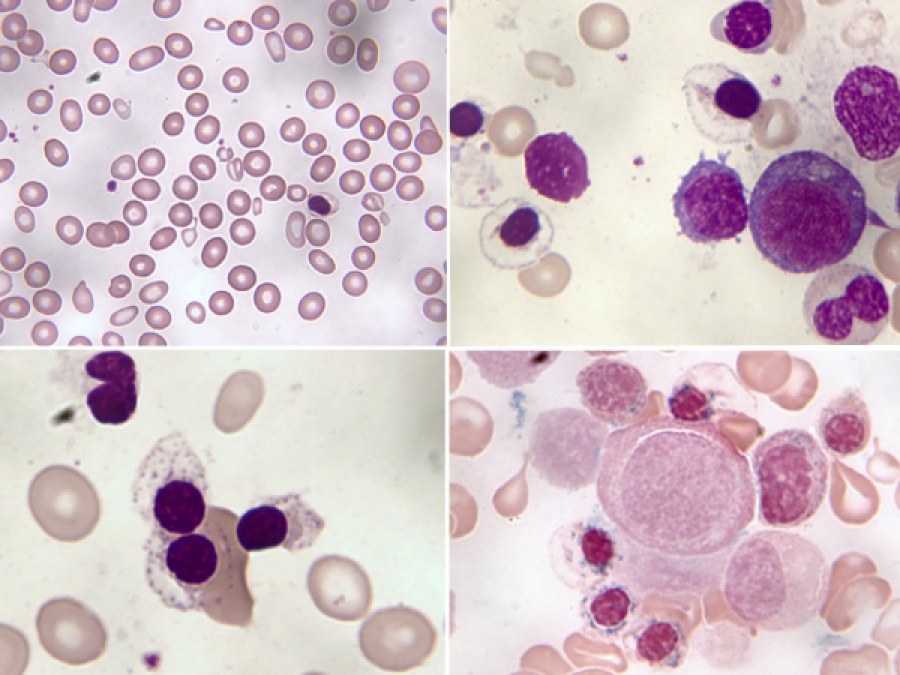
⚠Congenital sideroblastic anemia due to HSPA9 gene mutation. ✅A 14-year-old male with mild intellectual disability; with progressive fatigue in recent weeks.
✅Family history. No consanguinity between parents, healthy 10-year-old brother.
🔬In the photos below: 👉Top left. Peripheral blood: double population of red blood cells. Severe anisopoikilocytosis. Anisochromia. Circulating normoblast. 👉Top right and bottom left. Bone marrow: impaired hemoglobinization and basophilic stippling in mature erythroblasts. 👉Bottom right. Bone marrow (Perls’ stain): ring sideroblasts (87%). 🩸Blood test: ✅Hemoglobin 50 g/L, MCV 77 fL, MCH 23 pg; reticulocytes 14.4 x 10^9/L. Ferritin 275.9 µg/L (2 times above normal), transferrin saturation index 85%. ✅ NGS: pathogenic mutation c.1328T>C (p.Leu443Pro) and polymorphism c.1933C>T (p.Leu645=) found in the HSPA9 gene, both in heterozygous state, a combination compatible with congenital sideroblastic anemia. 👉Source of the clinical case: Hospital Universitario Virgen del Rocío, Seville, Spain. Camuñas Correa, Javier; Prats Martín et al. Image of the Month (July, 2023). ❗The HSPA9 gene encodes heat shock protein 70. The encoded protein is primarily localized in mitochondria, but is also found in the endoplasmic reticulum, plasma membrane, and cytoplasmic vesicles. This protein plays a role in cell proliferation, stress response, and in maintaining mitochondria.


